Spectrum and Network Measurements

Reflection measurements characterize a two-terminal port of a device under test. The device may have only one port or may have multiple ports. The fundamental measurement is the complex reflection coefficient (as a function of frequency). Often, the magnitude of the reflection coefficient is displayed on a decibel scale, resulting in a return loss measurement. The reflection coefficient can also be converted to other forms such as standing wave ratio and impedance. Using s parameter notation, the reflection coefficient may be referred to as s 11 or s 22 of a two-port device.
The fundamental reflection measurement is the complex reflection coefficient, which is the ratio of the reflected voltage to the incident voltage. [1]
| (16-1) | |
The magnitude of the reflection coefficient may be displayed on a linear scale but is more commonly shown in decibel form as return loss.
| (16-2) | |
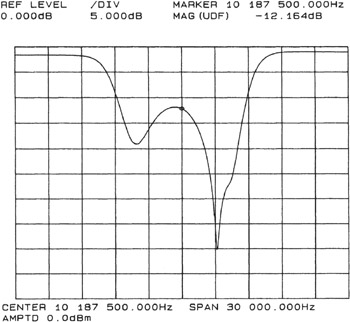
The return loss calculation includes a minus sign which causes the return loss values to be positive. When measured on a network analyzer, the minus sign is often omitted, producing measured values which are negative. For example, a network analyzer may read -40 dB, corresponding to a return loss of 40 dB. Figure 16-1 shows a typical return loss measurement of a bandpass filter.
Other...