Spectrum and Network Measurements

Chapter 5: Swept Spectrum Analyzers

The traditional method for implementing a spectrum analyzer is the swept heterodyne block diagram. Similar to a radio receiver, the spectrum analyzer is automatically tuned (swept) over the band of interest. This type of analyzer has been gradually replaced by the FFT analyzer at low frequencies, but the swept analyzer remains the dominant technology in the radio frequency range and above.

5.1 The Wave Analyzer

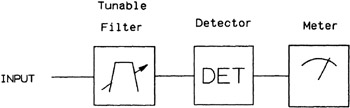
The bank-of-filters analyzer, which was examined in the previous chapter, uses a large number of fixed filters to implement a spectrum analyzer. Another approach is to use one filter, but to make it tunable over the frequency range of interest (Figure 5-1). Since this technique allows only one frequency to be measured at a time, it is not a true spectrum analyzer, but is called a wave analyzer or wave meter.


Figure 5-1: A conceptual block diagram of the wave analyzer.

The user tunes the wave analyzer to the frequency of interest and reads the signal level present at that frequency. The bandwidth of the tunable filter determines the resolution bandwidth, BW RES, of the wave analyzer. It is desirable for the filter to be as flattopped as possible, with steep skirts so that equal amplitude signals within the passband of the filter produce the same meter reading.

This type of instrument has been used extensively for making simple "tuned voltmeter" measurements and still exists today in the form of a selective level meter. Selective level meters have very ftattopped passbands, resulting...

UNLIMITED FREE
ACCESS
TO THE WORLD'S BEST IDEAS

SUBMIT
Already a GlobalSpec user? Log in.

This is embarrasing...

An error occurred while processing the form. Please try again in a few minutes.

Customize Your GlobalSpec Experience

Category: Spectrum Analyzers and Signal Analyzers
Finish!
Privacy Policy

This is embarrasing...

An error occurred while processing the form. Please try again in a few minutes.