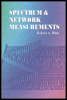
Spectrum and Network Measurements

Chapter 15: Transmission Measurements

The most common network measurement is characterizing the transmission through a device. In many electronic systems, the response at the output of a system block due to a signal at the input is a critical parameter. For distortionless transmission through a device, the output signal must be identical to the input signal, perhaps delayed in time and scaled in amplitude. This implies the device must have a flat amplitude response and a linear phase response. These criteria are not usually completely met, but can be approached in practice.

Measurement error is introduced into transmission measurements via a variety of mechanisms. These error mechanisms can be quantified so that the quality of the measurement is known.

15.1 Distortionless Transmission

A system or network is called distortionless if its output is an exact replica of its input, except for amplitude scaling and time delay. Put mathematically,

(15-1)

where

y( t)

=

output signal

x( t)

=

input signal

k

=

amplitude scale factor

t 0

=

time delay in the system

Note that k and t 0 are constants and are not allowed to be a function of frequency. Figure 15-1 shows an example of input and output signals of a linear system. The input pulse has an amplitude of 1 and a pulse width of T. The output is the same shape as the input but is delayed by t 0 and the amplitude of the output has been changed by the amplitude...

UNLIMITED FREE
ACCESS
TO THE WORLD'S BEST IDEAS

SUBMIT
Already a GlobalSpec user? Log in.

This is embarrasing...

An error occurred while processing the form. Please try again in a few minutes.

Customize Your GlobalSpec Experience

Category: IC Electronic Filters
Finish!
Privacy Policy

This is embarrasing...

An error occurred while processing the form. Please try again in a few minutes.