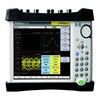
Spectrum and Network Measurements

The fast Fourier transform (FFT) can be used to implement a spectrum or network analyzer by digitizing the input waveform and performing an FFT on the time domain signal to get the frequency domain representation. What seems to be a simple measurement technique often turns out to be much more complicated in practice. Given reasonable computational power (usually in the form of a microprocessor or custom integrated circuit), the FFT-based analyzer can provide significant speed improvement over the more traditional swept analyzer. FFT analyzers usually have limited bandwidth (less than a few hundred kilohertz), due to the lack of fast, high-resolution analog-to-digital converters. The FFT analyzer is also referred to as the dynamic signal analyzer.
The bank-of-filters technique is not common in general electronic instrumentation but has been used in some applications, such as low-frequency audio meters (1/3-octave spectrum analyzers). This technique is included here to provide a theoretical base for discussing more practical spectrum analyzer block diagrams.
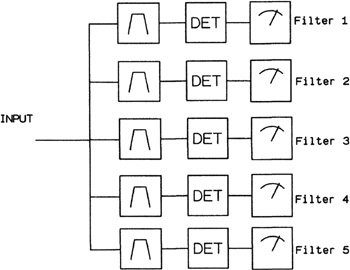
One simple approach to implementing a spectrum analyzer is to connect a bank of electronic filters together, each with its own output device (Figure 4-1). For a small number of filters, this technique has the advantage of simplicity. Also, this measurement technique is quite fast and can result in a real-time measurement system.
Each of the electronic filters is a bandpass filter tuned to a different center frequency. The...