Spectrum and Network Measurements

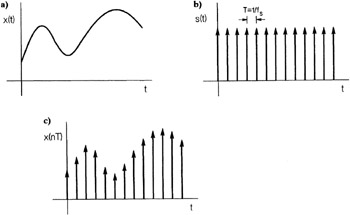
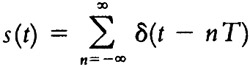
In a sampled system, the time domain waveform (Figure 4-6a) is effectively multiplied by the sample function (Figure 4-6b) to produce the sampled waveform (Figure 4-6c). The sampling function is shown as a series of impulse functions, spaced at T = 1 /f s, where f s is the sample rate of the system.
| (4-3) | |
When these impulse functions are multiplied with the original waveform, they produce a new series of impulse functions with each one weighted according to the original waveform.
| (4-4) | |
The sampled analog waveform is converted into a sequence of digital numbers using an analog-to-digital converter (ADC). The output of the ADC is an array or record of numbers representing the sampled waveform. The sampled and digitized version of the waveform still retains the shape and information content of the unsampled waveform, if the sample rate is sufficiently high.