Spectrum and Network Measurements

4.5: Sampling Theorem

4.5 Sampling Theorem

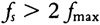
The waveform must be sampled often enough to produce a digitized time record that faithfully represents the original waveform. The sampling theorem states that a baseband signal must be sampled at a rate greater than twice the highest frequency present in the signal. The minimum acceptable sample rate is called the Nyquist rate. Thus,

(4-5)

where

f s

=

sample rate

f max

=

highest frequency present

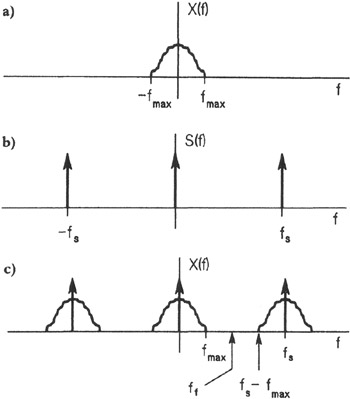
Figure 4-7a shows the frequency spectrum, X( f), of a signal, x( t), with a maximum frequency of f max. The frequency spectrum of the sampling function, as given by Table 3-1, is an infinite number of impulse functions spaced every f s in frequency (Figure 4-7b). The spectrum of the sampled waveform can be derived by convolving [1] X( f) with S( f), which results in the original spectrum X( f) appearing centered around each impulse function of S( f) (Figure 4-7c).


Figure 4-7: (a) The spectrum of the unsampled waveform. (b) The spectrum of the sampling function. (c) The spectrum of the sampled waveform.

This type of spectrum is always found in sampled systems-the baseband signal is repeated at integer multiples of the sample frequency. Notice that the spectrum between 0 and f s is symmetrical about f s/2, which is also called the folding frequency, f f. The original signal can be recovered by applying a low-pass filter...

UNLIMITED FREE
ACCESS
TO THE WORLD'S BEST IDEAS

SUBMIT
Already a GlobalSpec user? Log in.

This is embarrasing...

An error occurred while processing the form. Please try again in a few minutes.

Customize Your GlobalSpec Experience

Category: Analog-to-Digital Converters
Finish!
Privacy Policy

This is embarrasing...

An error occurred while processing the form. Please try again in a few minutes.