Spectrum and Network Measurements

Connecting an instrument to a device under test (DUT) invariably involves disturbing that device. When making precision measurements, it is desirable to minimize loading and other effects so that the measurement is not corrupted by the measuring instrument. Probes, attenuators, impedance matching devices, and filters are used to couple the signal of interest into the instrument in the most efficient and accurate manner.
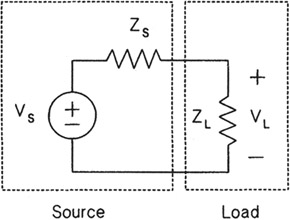
Any attempt to measure a voltage in a circuit will change that voltage. Consider the circuit shown in Figure 12-1. The circuit under test is modeled as a voltage source with some internal impedance, Z S. The open circuit voltage of the circuit is V S since no current can flow through Z S under open circuit conditions. When a load impedance, Z L is connected to the circuit, the situation changes. By the voltage divider relationship
| (12-1) | |
Unless Z S is equal to zero or Z L is equal to infinity, V L will always be less than V S.
Some electronic systems are designed to maximize the voltage transfer in the system. In order to maximize the voltage transfer, Z L should be made much larger than Z S. Thus, Z S is made as small as possible and Z L as large as possible. If Z L is...