Spectrum and Network Measurements

Also known as the Hann window, the Hanning window is one of the most common windows in digital signal processing. The time record samples are weighted by the following function:
| (4-13) | |
where
| n | = | bin number |
| N | = | number of bins |
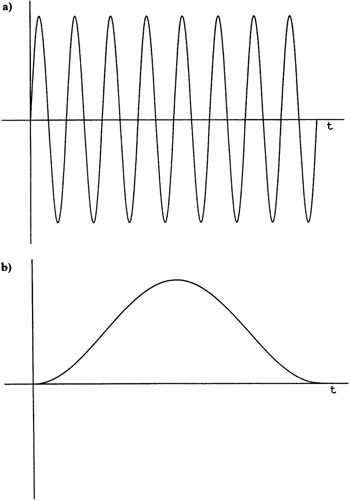
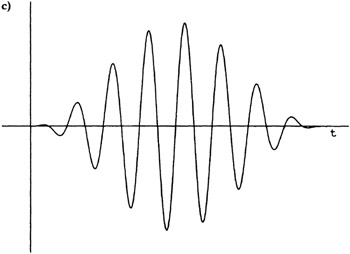
The Harming window provides a smooth transition to zero as either end of the time record is approached (Figure 4-18). Therefore, the windowed time record will not produce a transient when replicated by the FFT algorithm. Clearly, the original time record has been modified and the effect in the frequency domain must be considered. The shape of the Hanning window in the frequency domain is the Fourier transform of the window function.
The frequency domain response of the window function determines the passband shape of the individual filters that the FFT produces mathematically. Figure 4-19a shows the overlapped response of several frequency bins using a Hanning window. Notice that the filter shape is rounded off and that the net response of the analyzer drops off somewhat between bins. Therefore, a spectral line falling where the two filters meet will be measured with an error determined by the shape of the filter. The Hanning window introduces a maximum amplitude error of 1.5 dB (16%), which may be a significant error in some applications. The shape of a window is always a compromise between amplitude...