Spectrum and Network Measurements

4.9: Leakage

4.9 Leakage

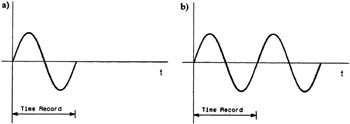
The FFT operates on a finite length time record in an attempt to approximate the Fourier transform, which integrates over all time. The mathematics of the FFT (and DFT) operate on the finite length time record, but have the effect of replicating the finite length time record over all time (Figure 4-15). [6] With the waveform shown in Figure 4-15b, the finite length time record represents the actual waveform quite well, so the FFT result will approximate the Fourier integral very well.


Figure 4-15: (a) A waveform that exactly fits one time record. (b) When replicated, no transients are introduced.

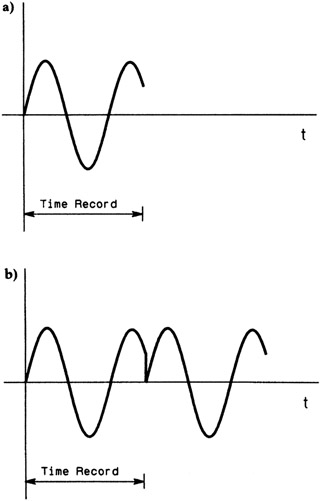
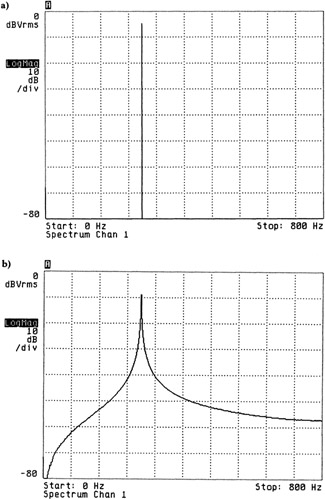
However, the shape and phase of a waveform may be such that a transient is introduced when the waveform is replicated for all time, as shown in Figure 4-16. In this case, the FFT spectrum is not a good approximation for the integral form of the Fourier transform. Since the instrument user often does not have control over how the waveform fits into the time record, in general, it must be assumed that a discontinuity may exist. This effect, known as leakage, is very apparent in the frequency domain. Instead of the spectral line appearing thin and slender, it spreads out over a wide frequency range (Figure 4-17).


Figure 4-16: (a) A waveform that does not exactly fit into one time record. (b) When replicated, severe transients are introduced, causing leakage in the frequency domain.

Figure 4-17: (a) Measurement of a spectral line with no leakage.

UNLIMITED FREE
ACCESS
TO THE WORLD'S BEST IDEAS

SUBMIT
Already a GlobalSpec user? Log in.

This is embarrasing...

An error occurred while processing the form. Please try again in a few minutes.

Customize Your GlobalSpec Experience

Category: Data Acquisition Systems and Instruments
Finish!
Privacy Policy

This is embarrasing...

An error occurred while processing the form. Please try again in a few minutes.