Spectrum and Network Measurements

4.8: Band Selectable Analysis

4.8 Band Selectable Analysis

By varying the sample rate, the frequency span of the analyzer can be controlled but the start frequency of the span is always at DC. The frequency resolution of the measurement can be improved arbitrarily but at the expense of a lower maximum frequency. Band selectable analysis (also known as zoom operation) allows the user to reduce the frequency span while maintaining a constant center frequency. In other words, the displayed frequency range is not limited to starting at DC. This is useful because very narrow spans away from DC can be analyzed.


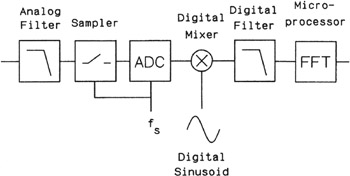
Figure 4-13: A digital mixer provides band selectable analysis in an FFT analyzer.

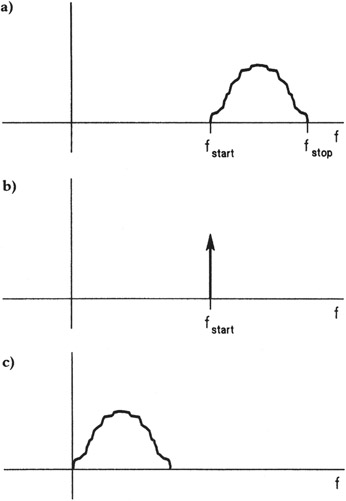
Band selectable analysis is accomplished by a change in the instrument block diagram (Figure 4-13). The output of the ADC is multiplied by a digital sinusoid, which mixes it down in frequency. [5] Many readers will recognize this as just a digital version of the heterodyne techniques often used in radio receivers and swept spectrum analyzers. The frequency span of interest (Figure 4-14) is mixed with a complex sinusoid at the center frequency, which causes that frequency span to be mixed down to baseband. The digital filter is configured for the proper span by using the appropriate decimation factor. The output of the digital filter is FFT'd to obtain the frequency spectrum. The bandwidth of the digital filter can be narrowed significantly, producing frequency spans as narrow as 1 Hz.


Figure 4-14: (a) The spectrum of the...

UNLIMITED FREE
ACCESS
TO THE WORLD'S BEST IDEAS

SUBMIT
Already a GlobalSpec user? Log in.

This is embarrasing...

An error occurred while processing the form. Please try again in a few minutes.

Customize Your GlobalSpec Experience

Category: Spectrum Analyzers and Signal Analyzers
Finish!
Privacy Policy

This is embarrasing...

An error occurred while processing the form. Please try again in a few minutes.