Spectrum and Network Measurements

The most familiar way of representing signals is in the time domain (i.e., a voltage or current represented as functions of time). An alternative representation which is extremely powerful and is inherent in spectrum and network measurements is the frequency domain representation, which describes the signal or system in terms of its frequency content (i.e., how much energy is present at each particular frequency). The frequency domain is related to the time domain by a body of knowledge generally known as Fourier theory, named for Jean Baptiste Joseph Fourier (1768-1830). This includes the series representation know as the Fourier series and the transform techniques known as the Fourier transform. Discrete (digitized) signals can be transformed into the frequency domain using the discrete Fourier transform.
A signal or function is periodic if it meets the following criterion:
| (3-1) | |
where T is the period of the function.
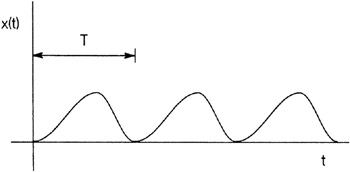
In other words, a periodic function can be shifted in time by exactly one period and the resulting new function will look the same as the original one. A periodic function of time repeats itself every T seconds (Figure 3-1).
Most periodic signals can be represented by a series expansion of sines and cosines. There are some mathematical limitations on the represented signal, but physically realizable signals meet these constraints. [1]
The Fourier series representation of a periodic function has the form [2]
| (3-2) |