Wireless and Cellular Telecommunications, Third Edition
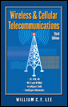
Just in time for the rebounding wireless industry, this updated classic text offers an in-depth engineering guide for both voice and data services, Wi-Fi, 3G, WiMAX, and more.
 TABLE OF CONTENTS
 In order to classify in this book the generations for mobile cellular development, it may be logical to use the multiple access schemes. The analog frequency division multiple access (FDMA) systems are 1G systems. The digital time division multiple access (TDMA) systems with circui switching are 2G systems. The code division multiple access (CDMA) systems with packet/circuit switching are 3G systems, and some different advanced mobile access technology used with an all Internet protocol (IP) network will be called 4G. However, because each technology itself is advanced with time, we use time periods to classify the generations. Those, analog systems are 1G, digital voice systems are 2G, digital voice/data systems are B2G, and broadband digital systems are 3G. Wireless local area network/wireless metropolitan area network (WLAN/WMAN) are B3G systems, and very-high-speed data-rate systems are 4G systems.
In 1964, Bell Laboratories formed a mobile communication department after the U.S. Congress took away the satellite communications business from AT&T. The early wireless networks only concentrated on voice communication. In the beginning, the analog systems named HCMTS (high-capacity mobile telephone system) were developed at Bell Labs in the period 1964-1974. The HCMTS used an FM modulation with a bandwidth of 30 kHz for both signaling and voice channels. The FM modulation index for voice is 4 which is the ratio of the frequency deviation (12 kHz) and the voice frequency (3 kHz). The signaling rate is 10 kbps. The system also migrated new...