Wireless and Cellular Telecommunications, Third Edition
Just in time for the rebounding wireless industry, this updated classic text offers an in-depth engineering guide for both voice and data services, Wi-Fi, 3G, WiMAX, and more.
 TABLE OF CONTENTS
 In an analog system, once a call is established, the set-up channel is not used again during the call period. Therefore, handoff is always implemented on the voice channel. In the digital systems, the handoff is carried out through paging or common control channel. The value of implementing handoffs is dependent on the size of the cell. For example, if the radius of the cell is 32 km (20 mi), the area is 3217 km2 (1256 mi2). After a call is initiated in this area, there is little chance that it will be dropped before the call is terminated as a result of a weak signal at the coverage boundary. Then why bother to implement the handoff feature? Even for a 16-km radius, cell handoff may not be needed. If a call is dropped in a fringe area, the customer simply redials and reconnects the call. Today the size of cells becomes smaller in order to increase capacity. Also people talk longer. The handoffs are very essential.
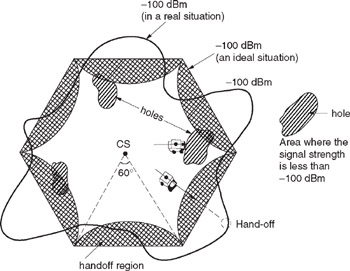
Handoff is needed in two situations where the cell site receives weak signals from the mobile unit: (1) at the cell boundary, say, 100 dBm, which is the level for requesting a handoff in a noise-limited environment; and (2) when the mobile unit is reaching the signal-strength holes (gaps) within the cell site as shown in Fig. 11.1.
In digital systems there are...