Wireless and Cellular Telecommunications, Third Edition
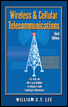
Just in time for the rebounding wireless industry, this updated classic text offers an in-depth engineering guide for both voice and data services, Wi-Fi, 3G, WiMAX, and more.
 TABLE OF CONTENTS
 The cochannel interference is usually involved with FDMA, TDMA, and OFDM A systems. The interference occurred because the frequency reuse scheme is applied to those systems in which the channels operate at the same frequency but repeatedly in separate locations. If the specified separation is large, the cochannel interference is reduced, but the number of the cochannel in a given area is also reduced. As a result, the capacity is reduced. Therefore, we have to find an optimal separation from which the reduction level of cochannel interference is acceptable and the capacity reaches to a maximum.
In a single-carrier CDMA system, every cell uses the same CDMA frequency carrier, and within the carrier, using different spreading codes creates the number of traffic channels. Therefore, there is no cochannel interference in CDMA but code channel interference among the traffic channels. For reducing the code channel interference, the power control is a very critical element. We will address it in this chapter.
The frequency-reuse method is useful for increasing the efficiency of spectrum usage but results in cochannel interference because the same frequency channel is used repeatedly in different cochannel cells. Application of the cochannel interference reduction factor q = D/R = 4.6 for a seven-cell reuse pattern (K = 7) is described in Sec.2.7. [1]
The cochannel interference reduction factor q = 4.6 is based on the system required C/I = 18 dB of the AMPS system. From q = 4.6 we...