Wireless and Cellular Telecommunications, Third Edition

Just in time for the rebounding wireless industry, this updated classic text offers an in-depth engineering guide for both voice and data services, Wi-Fi, 3G, WiMAX, and more.
 TABLE OF CONTENTS
 At the receiving end, dB ?V ?dBm (decibels above 1 ?V ?decibels above 1 mW) A receiving antenna at a distance r from the transmitting antenna with an aperture A will receive power P r

where ? is the Poynting vector.
We can also obtain the received power from Fig. D.1c
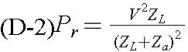
where V is the induced voltage in volts. For a maximum power delivery ZL = Z a [1], where the notation [1] indicates complex conjugate. Then, we obtain Z L + Z a = 2R L, where R L is the real-load resistance. Equation (D-2) becomes
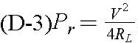
Assume that a dipole or a monopole is used as a receiving antenna. The induced voltage V can be related to field strength E as [1]
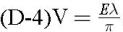
Where E is expressed in volts or microvolts per meter. Substitution of Eq. (D-3) into Eq. (D-4) yields
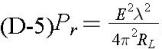
If we set R L = 50 ?, P r in decibels above 1 m, and E in decibels (microvolts per meter), Eq. (D-5) becomes

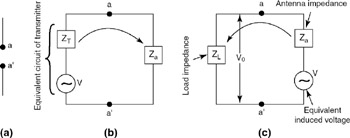
Figure D.l: An actual antenna and its equivalent circuit, (a) An actual antenna; (b) equivalent circuit of a transmitting antenna; (c) equivalent circuit of a receiving antenna
The notation "dB?V" in Eq. (D-6) is a simplification of decibels above 1 ?V/m and has been accepted by the Institute of Radio Engineers. We can find the equivalent aperture