Wireless and Cellular Telecommunications, Third Edition
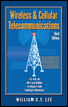
Just in time for the rebounding wireless industry, this updated classic text offers an in-depth engineering guide for both voice and data services, Wi-Fi, 3G, WiMAX, and more.
 TABLE OF CONTENTS
 Switching equipment is the brain of the cellular system. It consists of two parts: the switch and the processor. The switch is no different from that used in the telephone central office. The processor used in cellular systems is a special-purpose computer. It controls all the functions that are specific for cellular systems, such as frequency assignment, decisions regarding handoff (including decisions regarding new cells for handoff), and monitoring of traffic. The smaller the cell, the more handoffs involved, and the greater the traffic load required. The processor can be programmed to correct its own errors and to optimize system performance. General (noncellular) telephone switching equipment is described first, and then cellular switching equipment is discussed in detail.
In the AMPS system, the MTSO is able to handle all the cellular network functions. When the digital systems were developed, the MTSO became less sufficient to handle all the newly developed functions. Thus, the base station controller (BSC) was born. BSC is a part of the wireless system's infrastructure that controls one or multiple cell sites' radio signals, thus reducing the load of switch. It performs radio signal management functions for base transceiver stations, managing functions such as frequency assignment and handoffs. Because BSC's functions are a part of switching systems, we may include it in the switching systems. In this book, MSO (mobile switching office) is a general term for any switch: MTSO, BSC, MSC or packet switch.
The history and the trend of...