Wireless and Cellular Telecommunications, Third Edition
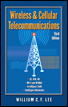
Just in time for the rebounding wireless industry, this updated classic text offers an in-depth engineering guide for both voice and data services, Wi-Fi, 3G, WiMAX, and more.
 TABLE OF CONTENTS
 Implementation of data links is an integral part of cellular mobile system design, and the performance of data links significantly affects overall cellular system performance.
The cell site receives the data from the MSO [*] to control the call process of mobile units. It also collects data from the reverse set-up channel from active mobile units and attempts to send it to the MSO. There are four types of data links available: (1) wire line, (2) 800-MHz radios, (3) microwaves, and (4) optical link. The following discussion describes each alternative and its advantages and disadvantages. The wireline connection [1] uses the telephone company's Tl carrier. Regular telephone wire can transmit only at a low rate (2.4 kbps); therefore, a high-data-rate cable must be leased. The Tl carrier has a wideband transmission (1.5 Mbps) that consists of 24 channels, and each channel can transmit at arate of 64 kbps. The Tl carrier is also called DSI, a standard data link used in North America, Japan, and Korea. It is a TDM (Time Division Multiplexing) Hierarchy. There are different rates of carriers as shown below:
| Designation | Channels | Data Rate (Mb/s) | Comments |
|---|---|---|---|
| DS-0 | 1 | 0.064 | 8 kHz 8 bits PCM voice channel |
| DS-1 | 24 | 1.544 | T-1 1 timing bit/frame |
| DS-1c | 48 | 3.152 | T-1c |
| DS-2 | 96 | 6.312 | T-2 |
| DS-3 | 672 | 44.736 | T-3 |
| DS-4 | 4032 | 274.176 | T-4 |
The El Carrier has a wideband transmission (2.048 Mbps) that consists of 32 channels, and each channel can transmit at a rate of 64...