Wireless and Cellular Telecommunications, Third Edition
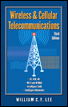
Just in time for the rebounding wireless industry, this updated classic text offers an in-depth engineering guide for both voice and data services, Wi-Fi, 3G, WiMAX, and more.
 TABLE OF CONTENTS
 The analog cellular system was a successful model in wireless communication and led to the digital cellular systems with several evolutions from FDMA to TDMA and to CDMA as of today. There are many clever techniques that have been implemented in the analog system. In the analog system, the signaling channels are only used for call establishing. After the call is connected, the traffic channel handles both voice and signaling by using the property of Manchester code. The use of SAT (Supervisory Audio Tone) for on-hook and off-hook as well as the identification of cells is also clever; of course, the invention of handoffs, used while at a weak-signal condition (at cell boundary), is another great contribution. Therefore, it is worthwhile to include discussion of the analog cellular system in this book.
In this chapter, we concentrate on U.S. analog cellular mobile specifications [1] as well as the elements and parameters of the analog system. [2] [3] Also, we touch on the differences in other foreign analog cellular mobile systems.
[1]FCC OST, "Cellular System Mobile Station Land Station Compatibility Specification," OST Bulletin, No. 53, July 1983.
[2]"Advanced Mobile Phone Service," special issue, Bell System Technical Journal, Vol. 58, January 1979.
[3]"Code of Federal Regulations," FCC, part 22 1986, pp. 85-190.
Home mobile station (unit). A mobile station that is subscribed in its cellular system.
Land station. A station other than a mobile station, which links...