Wireless and Cellular Telecommunications, Third Edition
Just in time for the rebounding wireless industry, this updated classic text offers an in-depth engineering guide for both voice and data services, Wi-Fi, 3G, WiMAX, and more.
 TABLE OF CONTENTS
 ITU has called the future cellular networks 3G networks or IMT-2000; the previous term was Future Public Land Mobile Telephone System (FPLMTS). The performance for IMT-2000 air interference can be summarized as: [1] [2] [3]
Wideband CDMA systems
Spectrum bandwidth 5 MHz
Full coverage and mobility for a data rate of 144 kbps to 384 kbps
Limited coverage and mobility or no mobility for 2 Mbps
High spectrum efficiency compared to 2G system
High flexibility to introduce new and multimedia services
The 3G features:
Provision of multirate services
Packet data
A user-dedicated pilot for a coherent uplink
An additional DL pilot channel for beam forming
Intercarrier handover
Fast power control
Multiuser detection
IMT-2000 has published a minimum performance requirement of a 3G wireless system, which is for both circuit-switched (CS) and packet-switched (PS) data:
Data rate of 144 kbps in the vehicular environment
Data rate of 384 kbps in the pedestrian environment
Data rate of 2 Mbps in the fixed indoor and pico cell environment
The 3G systems concentrating on the three ITU-adopted systems using CDMA technology are WCDMA-UTRA (Europe), WCDMA-ARIB (Japan), and cdma2000 (North America).
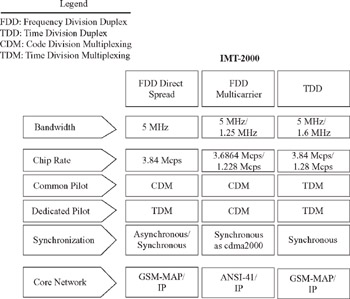
3G consists of the three systems shown in Fig. 6.1, also called three modes because in the future, the three systems can have the features of hooks and extension to make intersystem connections among them.
[1]E. Nikula, A. Toshala, E. Dahlman, L. Girad, A. Klein, "FRAMES Multiple Access for UMTS and IMT-2000", IEEE Personal Communications Magazine,...