Wireless and Cellular Telecommunications, Third Edition
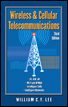
Just in time for the rebounding wireless industry, this updated classic text offers an in-depth engineering guide for both voice and data services, Wi-Fi, 3G, WiMAX, and more.
 TABLE OF CONTENTS
 In the cellular industry, system capacity is a great issue. As demand for cellular service grows, system operators try to find ways to increase system capacity. Capacity can be increased by reducing the cell sizes. This is called the conventional microcell approach, but it does not provide intelligence. When the cell size becomes smaller, the control of interference among the cells becomes harder. Also, the handoff time from the beginning of the initiation to the action completion sometimes may take around 15 s. If a mobile station is moving at a speed of 25 km/h (7 m/s), then the mobile station will travel 105 m in 15 s; at a speed of 50 km/h, the mobile station travels 205 m in 15 s. Because within a microcell of 0.5-km radius the overlapped region for a handoff is very small, then the mobile station is in the overlapped region too short a time for the handoff action to be complete. As a result, the call drops. In a conventional microcell system, interference is hard to control and the handoffs may not have enough time to complete.
The intelligent cell can solve the two problems. The intelligent cell concept can be used not only in microceils but also in regular cells to bring extra capacity to the system.
There are two definitions to describe an intelligent cell. One definition of intelligent cell is that the cell is able to intelligently monitor...