Wireless and Cellular Telecommunications, Third Edition
Just in time for the rebounding wireless industry, this updated classic text offers an in-depth engineering guide for both voice and data services, Wi-Fi, 3G, WiMAX, and more.
 TABLE OF CONTENTS
 In the previous sections, GSM, NA-TDMA, and CDMA were introduced. This section will briefly introduce other systems such as PDC, CT-2, DECT, CDPD, PCN, and PCS. iDEN and PHS will be described in Chapter 5.
Time-division duplexing (TDD) systems are digital systems and use only one carrier to transmit and receive information. There are two kinds of TDD systems (see Fig. 4.58):
TDD/FDMA each carrier serves only one user.
TDD/TDMA each carrier can have many time slots and each slot can serve one user. Then N transmit time slots can serve N users.
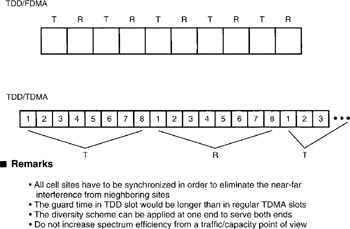
A TDD system is used when only one chunk of spectrum is allocated. In cellular systems, there are two chunks of spectrum, separated by 20 MHz. In each cellular channel, the base transmit frequency and the mobile transmit frequency are 45 MHz apart. Therefore, the separation in frequency between transmitting and receiving is adequate to avoid interference. In TDD, there is no separation in frequency between transmitting and receiving but a separation in time interval.
The advantages of TDD are as follows:
When only one chunk of spectrum is available, TDD is the best use of spectrum.
Diversity can be applied at one end (terminal) to serve both ends, as the fading characteristics of one carrier are the same when received at both ends. At the base station, the information on selecting antennas for the space-diversity selective combining receiver can be used to switch to one...