Wireless and Cellular Telecommunications, Third Edition
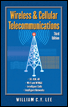
Just in time for the rebounding wireless industry, this updated classic text offers an in-depth engineering guide for both voice and data services, Wi-Fi, 3G, WiMAX, and more.
 TABLE OF CONTENTS
 North American TDMA (NA-TDMA) is a digital cellular system [22] [23] [24] sometimes called American digital cellular (ADC) or digital AMPS (DAMPS), or North American digital cellular (NADC) or IS-54 system. This TDMA system was approved and design on it was started in 1987 by a group named TR45-3 after the industry debated between frequency-division multiple access and time-division multiple access. The reason those members voted for TDMA was due to the big influence of European GSM, which is the TDMA system. However, the requirements of designing a digital cellular system in Europe and in North America are different. In Europe, there is a virgin band (935-960 MHz downlink and 890-915 MHz uplink) for the digital cellular system. In North America, there is no new allocated band for the digital cellular system. The digital cellular system has to share the same allocated band with the analog system (AMPS, described in Chap. 3). Also, the digital and the analog systems have to be coexistent. In this circumstance, the low-risk approach is to use the same signal signature as the analog system (i.e., FDMA). Besides, because of the urgent need for large system capacity, the time for designing a new North American system had to be very short. The North American digital system was needed to be available in 1990, in only 3 years. To design a digital FDMA system would be a straightforward task. Since the analog system is a FDMA system, all the...