Wireless and Cellular Telecommunications, Third Edition
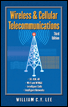
Just in time for the rebounding wireless industry, this updated classic text offers an in-depth engineering guide for both voice and data services, Wi-Fi, 3G, WiMAX, and more.
 TABLE OF CONTENTS
 Those wireless systems developed after digital TDMA and CDMA systems are classified as B2G systems: these are GPRS, EDGE, HSCSD, iDEN, PHS, and RTT1X (IS-95B). Each of them is described in this chapter.
GSM is not necessarily an efficient system for the support of data traffic. The GPRS is a solution [1] [2] that provides more efficient packet-based data services at higher data rates. Besides, UMTS Release 99 reuses a great deal of GPRS functionality for WCDMA. In this section, we briefly describe the GPRS system, as the packed-switched system appearing in WCDMA will be shown in Chapter 6.
GPRS has the same basic air interface as GSM, a 200-kHz channel divided into eight time-slots. GPRS, however, defines four different channel coding schemes, CS-1 to CS-4 with different data rates. The most commonly used coding scheme for packet data transfer is coding scheme 2 (CS-2), which enables a given time slot to carry data at a transmission rate of 13.4 kbps. The data rate for usable data is approximately 20 to 30 percent less than the transmission rate.
The advantage of GPRS is the use of packet-switching technology. It enables multiple users to share air interface resources. Because this is a request-allocation procedure, the users feel their services to be "always on."
A given time slot is called Packet Data Channel (PDCH) when it is used to carry GPRS-related data traffic or control signaling. Although GPRS uses the same...