Wireless and Cellular Telecommunications, Third Edition
Just in time for the rebounding wireless industry, this updated classic text offers an in-depth engineering guide for both voice and data services, Wi-Fi, 3G, WiMAX, and more.
 TABLE OF CONTENTS
 CEPT, a European group, began to develop the Global System for Mobile TDMA system in June 1982. [17] [18] [19] [20] [21] GSM has two objectives: pan-European roaming, which offers compatibility throughout the European continent, and interaction with the integrated service digital network (ISDN), which offers the capability to extend the single-subscriber-line system to a multiservice system with various services currently offered only through diverse telecommunications networks.
System capacity was not an issue in the initial development of GSM, but due to the unexpected, rapid growth of cellular service, 35 revisions have been made to GSM since the first issued specification. The first commercial GSM system, called D2, was implemented in Germany in 1992.
GSM consists of many subsystems, such as the mobile station (MS), the base station subsystem (BSS), the network and switching subsystem (NSS), and the operation subsystem (OSS) (see Fig. 4.20).
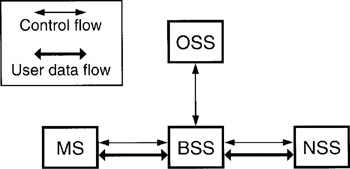
The MS may be a stand-alone piece of equipment for certain services or support the connection of external terminals, such as the interface for a personal computer or fax. The MS includes mobile equipment (ME) and a subscriber identity module (SIM). ME does not need to be personally assigned to one subscriber. The SIM is a subscriber module which stores all the subscriber-related information. When a subscriber's SIM is inserted into the ME of an MS, that MS belongs to the subscriber,...