
Structural Stress Force and Load Sensors
Last Updated: April 1, 2025
Description
Structural Stress Force and Load Sensors are devices designed to measure the force, load, or stress applied to a structure. These sensors detect changes in physical quantities such as force and deformation, providing critical data for assessing the structural integrity and performance of various materials and components.
Working Principle
The fundamental principle behind these sensors often involves the use of strain gauges. When a force is applied, the sensor deforms slightly, causing strain on the built-in strain gauges. These gauges are electrical resistors whose resistance changes proportionally with the applied force. This change in resistance is then transformed into an electrical output, which can be measured and calibrated to determine the force or stress exerted on the sensor . The piezoelectric effect is another principle used in active mechanical sensors, where the deformation of a piezoelectric material generates an electrical charge proportional to the applied force .
Applications
Structural Stress Force and Load Sensors are used in a variety of applications. For example, they are critical in the aerospace industry for monitoring the stress on aircraft components during flight. In civil engineering, these sensors are used to measure the load on bridges and buildings to ensure safety and structural integrity. They are also employed in the manufacturing sector to monitor the force applied during machining processes, ensuring precision and quality control.
Advantages over other Force and Load Sensors
Load cells, a type of force sensor, offer unparalleled accuracy in measuring force and weight, making them essential in applications where precision is paramount. They are highly reliable due to their robust construction, capable of withstanding harsh environmental conditions. Additionally, load cells are versatile, available in various shapes and sizes to cater to a wide range of applications and load capacities .
Limitations
One limitation of these sensors is their sensitivity to environmental factors such as temperature and humidity, which can affect their accuracy and reliability. Additionally, the initial cost of high-precision sensors can be significant, which may be a barrier for some applications.
Considerations
When selecting Structural Stress Force and Load Sensors, several factors should be considered. Initial costs can vary significantly depending on the precision and type of sensor required. Operating expenses may include calibration and maintenance to ensure accuracy over time. Durability is a critical factor, especially in harsh environments, as it affects the sensor's lifespan and reliability. Accuracy is paramount in applications where precise measurements are crucial. Replacement and maintenance costs should also be factored into the overall cost of ownership, as regular calibration and potential sensor replacement can add to the long-term expenses.

from NOSHOK, Inc.
Engineered to provide superior performance in level measurement, rope and belt tension and torque measurement, bearing support forces on lifting equipment and other compression force measurement applications. Ranges from 230 lbs.-force to 500,000 lbs.-force. Accuracy levels range from ±0.125%... [See More]
- Application: Structural Stress; Weigh Scales
- Accuracy: 0.12 to 0.50
- Force Rating: 90000 to 220000
- Force Measured: Compression
from NOSHOK, Inc.
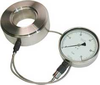
Designed in a distinctive ring shape to provide superior performance in compression or tension force measurement applications. Ranges from 900 lbs.-force to 630,000 lbs.-force. Accuracy levels range from ±0.125% Full scale (B.F.S.L.) to ±1.5% Full scale, depending on the measuring... [See More]
- Application: Structural Stress
- Accuracy: 0.12 to 0.50
- Force Rating: 76000 to 250000
- Force Measured: Tension; Compression