
Instrument / Meter Force and Load Sensors
Last Updated: April 1, 2025
Description
Instrument/Meter Force and Load Sensors are devices designed to measure the force or load applied to them. These sensors convert the physical force exerted on them into an electrical signal that can be quantified and analyzed. They are essential tools in various industries for precise measurement of force, load, and weight.
Working Principle
The fundamental principle behind force and load sensors, such as load cells, involves the use of strain gauges. When a force is applied to the sensor, it deforms slightly, causing strain on the built-in strain gauges. These gauges are electrical resistors whose resistance changes proportionally with the applied force. This change in resistance is then transformed into an electrical output, which can be measured and calibrated to determine the force or weight exerted on the sensor . This principle allows for high precision and accuracy in measurements, making these sensors invaluable in applications where exact force measurement is critical.
Applications
Force and load sensors are used in a wide range of applications. In industrial settings, they are employed in weighing machines and load cells for measuring the weight of goods. In the automotive and aerospace industries, they are used to measure forces in engines and structural components. Additionally, they are utilized in the packaging industry to ensure the correct torque is applied to screw caps on medicine bottles and other containers .
Advantages over other Force and Load Sensors
Load cells offer several advantages over other types of force and load sensors. They provide unparalleled precision and accuracy, which is crucial in applications where exact measurements are necessary. Their robust construction ensures reliability and the ability to withstand harsh environmental conditions. Furthermore, load cells are versatile, available in various shapes and sizes to accommodate a wide range of applications and load capacities .
Limitations
One limitation of certain force measurement methods, such as using motor current to calculate force, is the potential for large errors and measurement uncertainties due to power losses and varying operating modes of the machine. This can be a significant drawback in applications where high accuracy is required .
Considerations
When selecting force and load sensors, several considerations should be taken into account. Initial costs can vary depending on the type and specifications of the sensor. Operating expenses may include calibration and maintenance to ensure continued accuracy. Durability is a key factor, as sensors must withstand environmental influences such as temperature, vibration, and humidity. Accuracy is paramount, with some applications requiring measurement accuracy levels better than 0.01% of full scale ranges. Replacement and maintenance costs should also be considered, as these can impact the long-term cost-effectiveness of the sensor .

from ABB Measurement & Analytics
The Pressductor Radial Load Cells are ideal for applications on a wide range of web processing machinery in the converting, plastic film, printing, textiles, and other industries. [See More]
- Device: Sensor / Transducer; Instrument / Meter
- Force Measured: Tension
- Force Rating: 112 to 1124
- Output: Analog Current; Analog Voltage
from Mecmesin Corporation
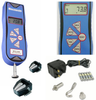
It can be used handheld or fixed to a manual or motorised test stand for excellent testing performance, providing consistently accurate force measurement. For improved accuracy and additional functionality, have a look at the Advanced Force Gauge. [See More]
- Device: Instrument / Meter
- Accuracy: 0.25
- Force Rating: 2.25 to 562
- Output: RS-232 / RS-422 / RS-485

from NOSHOK, Inc.
Features & Benefits. For friction clutch testing on chain hoists. Rugged design, light weight. The force transducer is inserted into the chain, travels upwards with it against the base of the chain hoist and thereby blocks the chain. An easy to use, precise, durable and dependable tester for... [See More]
- Device: Sensor / Transducer; Instrument / Meter; Recorder / Totalizer
- Accuracy: 0.00 to 2.50
- Force Rating: 88 to 7700
- Force Measured: Tension
from Norbar Torque Tools, Inc.
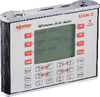
The Ultrasonic Stress Meter - USM-3 is a hand held instrument including; AC adaptor, nylon carrying case, storage case, transducer cable, RS232 data transfer cable, 4 oz couplant and operation manual. [See More]
- Device: Instrument / Meter
- Force Measured: Tension
- Accuracy: 0.00
- Output: Analog Voltage; Digital; RS-232 / RS-422 / RS-485
from United Testing Systems, Inc.
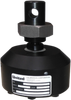
Technically known as precision electronic force measuring units, United's Load Cells are designed to precisely measure the amount of force (load) applied to the specimen being tested. Available in single or dual bridge, United load cells offer the flexibility of using two readouts simultaneously, if... [See More]
- Device: Sensor / Transducer; Instrument / Meter
- Accuracy: 0.50
- Force Rating: 1 to 120000