
Capacitive Force and Load Sensors
Last Updated: April 1, 2025
Description
Capacitive force and load sensors are devices that measure force or load by detecting changes in capacitance. These sensors typically consist of two parallel plates, where one plate is fixed and the other is attached to a load-bearing element. When a force is applied, the separation between the plates changes, which alters the capacitance. This change is then converted into an electrical signal that can be measured and analyzed.
Working Principle
Capacitive force and load sensors operate on the principle of capacitance change. The sensors consist of two parallel and electrically isolated conducting plates. When a force is applied, the distance between these plates changes, leading to a variation in capacitance. This change in capacitance is then translated into an electrical signal, which can be processed by an ASIC or microcontroller to provide a precise measurement of the applied force or load. The utility of these sensors lies in their ability to offer high accuracy and low power consumption, making them suitable for applications where precision and energy efficiency are critical .
Applications
Capacitive force and load sensors are used in a variety of applications. They are particularly useful in environments where high accuracy and reliability are required. For instance, they are employed in medical devices for remote or implanted applications due to their low power consumption and high precision. Additionally, these sensors are used in industrial settings where accurate force measurement is crucial for automation and control processes .
Advantages over other Force and Load Sensors
Compared to piezoresistive sensors, capacitive sensors offer several advantages. They provide higher accuracy and a lower total error band. Capacitive sensors also consume less power because there is no direct current flowing through the sensor element. This makes them ideal for applications that require low power consumption, such as remote sensing or implanted medical devices .
Limitations
Capacitive sensors have some limitations, including potentially high impedance output and sensitivity to temperature changes, which necessitates ambient temperature compensation. They also require custom electronics to produce a stable output and may be susceptible to long-term drift due to their analog sensor design .
Considerations
When considering capacitive force and load sensors, it is important to evaluate factors such as initial costs, operating expenses, and maintenance requirements. These sensors may have higher initial costs due to the need for custom electronics and calibration. However, their low power consumption can reduce operating expenses over time. Durability and accuracy are generally high, but users should be aware of potential long-term drift and the need for periodic recalibration to maintain precision. Replacement and maintenance costs should also be considered, especially in applications where sensors are exposed to harsh environmental conditions .

from Andantex USA, Inc.
Andantex ’s Cantilevered Full Bridge transducer idlers are designed for accurate, repeatable tension measurement of paper, film, foil and other narrow web materials. Every transducer incorporates four semi-conductor strain sensing gauges – two at each end of the roller. The gauges... [See More]
- Technology: Capacitive
- Package: Rod End - Female
- Force Measured: Tension; Compression
- Output: M12

from Baumer Ltd.
Load cells can be used in static and high dynamic applications and can be loaded by compression or tension/compression. Load cells stand for high-precision and low noise signal processing. • Characteristic curve deviation 0,5%. • Nominal force 5...10 kN. • Output signal 1mV/V. •... [See More]
- Technology: Capacitive
- Accuracy: 0.50
- Force Rating: 0.0 to 2248
- Force Measured: Compression

from Andantex USA, Inc.
Our under-pillow block load cells offer unmatched performance even in harsh environments with a 100% stainless steel construction: High tension signal sensitivity. Easy installation design. High Degree of Overload Protection. Water & Dust Proof, Pillow Block Load Cells are waterproof up to 1... [See More]
- Technology: Capacitive
- Package: Pancake
- Force Measured: Tension
- Output: M12

from Baumer Ltd.
Load cells can be used in static and high dynamic applications and can be loaded by compression or tension/compression. Load cells stand for high-precision and low noise signal processing. • Characteristic curve deviation 0,3%. • Nominal force 0,5...10 kN. • Output signal 2 mV/V. [See More]
- Technology: Capacitive
- Accuracy: 0.30
- Force Rating: 0.0 to 2248
- Force Measured: Tension; Compression
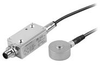
from Baumer Ltd.
Load cells can be used in static and high dynamic applications and can be loaded by compression or tension/compression. Load cells stand for high-precision and low noise signal processing. • Characteristic curve deviation 0,5%. • Nominal force 5...10 kN. • Output signal 0 ... 10 V / 4... [See More]
- Technology: Capacitive
- Accuracy: 0.50
- Force Rating: 0.0 to 2248
- Force Measured: Compression

from Baumer Ltd.
Load cells can be used in static and high dynamic applications and can be loaded by compression or tension/compression. Load cells stand for high-precision and low noise signal processing. • Characteristic curve deviation 0,3%. • Nominal force 0,5...10 kN. • Output signal 0 ... 10 V /... [See More]
- Technology: Capacitive
- Accuracy: 0.50
- Force Rating: 0.0 to 2248
- Force Measured: Tension; Compression

from Baumer Ltd.
Load cells can be used in static and high dynamic applications and can be loaded by compression or tension/compression. Load cells stand for high-precision and low noise signal processing. • Characteristic curve deviation 0,3%. • Nominal force 0,5...10 kN. • Output signal 2 mV/V. [See More]
- Technology: Capacitive
- Accuracy: 0.30
- Force Rating: 0.0 to 2248
- Force Measured: Tension; Compression