
Recorder / Totalizer Force and Load Sensors
Last Updated: April 1, 2025
Description
Recorder/Totalizer Force and Load Sensors are devices designed to measure and record the force or load applied to an object. These sensors convert the physical force into an electrical signal that can be quantified and recorded for analysis. They are essential in providing precise measurements of force, which can be critical in various engineering and industrial applications.
Working Principle
The working principle of Recorder/Totalizer Force and Load Sensors is based on the deformation of strain gauges. When a force is applied to the sensor, it deforms slightly, causing a change in the resistance of the strain gauges. This change in resistance is then converted into an electrical signal, which can be measured and calibrated to determine the exact force or load applied. This principle allows for high precision and accuracy in force measurement, making these sensors invaluable in situations where precise force data is necessary.
Applications
Recorder/Totalizer Force and Load Sensors are used in a variety of specific applications. For example, they are employed in tunnel jacking operations to monitor the force applied during the process, ensuring structural integrity and safety. They are also used in semiconductor production, where precise force measurement is crucial for the accurate placement and bonding of components.
Advantages over other Force and Load Sensors
One of the primary advantages of these sensors is their precision and accuracy, which are critical in applications where exact force measurements are required. They are also highly reliable and capable of withstanding harsh environmental conditions, making them suitable for a wide range of applications. Additionally, their versatility in terms of shapes and sizes allows them to cater to various load capacities and application needs.
Limitations
A notable limitation of Recorder/Totalizer Force and Load Sensors is their sensitivity, which can be relatively low, typically ranging between 1 mV/V to 10 mV/V. This can affect their performance in applications requiring the detection of very small force changes. Additionally, certain types of load cells, such as piezoelectric sensors, may have limitations in terms of temperature influences and static measurements.
Considerations
When considering the use of Recorder/Totalizer Force and Load Sensors, several factors should be taken into account. Initial costs can vary depending on the type and specifications of the sensor. Operating expenses may include calibration and maintenance to ensure accuracy over time. Durability is generally high, but it is essential to consider the environmental conditions in which the sensor will operate. Accuracy is a significant advantage, but it is crucial to ensure that the sensor is suitable for the specific application requirements. Replacement and maintenance costs should also be factored into the overall cost of ownership, as regular calibration and potential sensor replacement may be necessary to maintain performance.

from NOSHOK, Inc.
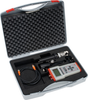
Features & Benefits. For friction clutch testing on chain hoists. Rugged design, light weight. The force transducer is inserted into the chain, travels upwards with it against the base of the chain hoist and thereby blocks the chain. An easy to use, precise, durable and dependable tester for... [See More]
- Device: Sensor / Transducer; Instrument / Meter; Recorder / Totalizer
- Accuracy: 0.00 to 2.50
- Force Rating: 88 to 7700
- Force Measured: Tension
from NOSHOK, Inc.
Features & Benefits. For easy and accurate measurement of electrode force on spot welding equipment. To check the force acting on the electrodes, the force transducer is held between the electrodes. The concave surfaces center the force transducer. When the welding electrodes come together, the... [See More]
- Device: Sensor / Transducer; Instrument / Meter; Recorder / Totalizer
- Accuracy: 0.20
- Force Rating: 0.0 to 2240
- Output: Digital (optional feature)