
60-40 Scratch / Dig Optical Prisms
Description
60-40 Scratch / Dig Optical Prisms are precision optical components characterized by their surface quality specifications. The "60-40" designation refers to the surface quality, where the average length of scratches is 0.60 mm and the average diameter of digs is 0.40 mm. These prisms are used to manipulate light through refraction or reflection, and their surfaces are polished to achieve the specified scratch and dig quality, ensuring minimal optical distortion.
Working Principle
Optical prisms work by altering the path of light through refraction or total internal reflection. When light enters a prism, it bends at the interface between air and the prism material due to the change in refractive index. This bending of light can be used to change the direction of the light beam, disperse light into its component colors, or reflect light at precise angles. The 60-40 scratch/dig specification ensures that the surface imperfections are minimized, which is crucial for maintaining the integrity of the light path and achieving high precision in optical applications.
Applications
60-40 Scratch / Dig Optical Prisms are used in a variety of optical systems where moderate surface quality is acceptable. Specific examples include:
- Spectroscopy: Used in spectrometers to disperse light into its component wavelengths for analysis.
- Laser Systems: Employed in laser optics to redirect beams with minimal distortion.
- Imaging Systems: Utilized in cameras and telescopes to correct image orientation and improve image quality.
Advantages over other Optical Prisms
The 60-40 scratch/dig specification offers a balance between cost and performance. Compared to higher quality prisms like those with a 10-5 or 20-10 specification, 60-40 prisms are more cost-effective while still providing adequate performance for many applications. This makes them suitable for systems where ultra-high precision is not critical but where cost savings are important.
Limitations
The primary limitation of 60-40 Scratch / Dig Optical Prisms is their surface quality, which may not be sufficient for high-precision applications that require minimal optical distortion. The larger scratches and digs compared to higher-grade prisms can introduce scattering and reduce the overall optical performance in sensitive systems.
Considerations
When selecting 60-40 Scratch / Dig Optical Prisms, consider the following:
- Initial Costs: These prisms are generally more affordable than higher-grade options, making them a cost-effective choice for less demanding applications.
- Operating Expense: The moderate surface quality may lead to increased maintenance costs if used in environments where optical performance is critical.
- Durability: While durable, the surface imperfections may make them more susceptible to damage in harsh conditions.
- Accuracy: The 60-40 specification provides moderate accuracy, suitable for applications where ultra-high precision is not required.
- Replacement and Maintenance Costs: Lower initial costs may be offset by higher maintenance and replacement costs if the prisms are used in applications beyond their intended performance range.
from Newport MKS
The LPH-PIP-4 Light Pipe Homogenizer provides highly uniform or homogenized illumination. Through the process of total internal reflection, this 4 x 4 x 50 mm light pipe can transform the output of a very non-uniform light source into highly uniform or homogenized illumination. For maximum... [See More]
- Surface Quality: 60-40 Scratch / Dig; 60-40 scratch-dig
- Prism Material: BK7 Glass
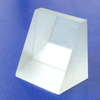
from CeNing Optics Co., Ltd.
The Anamorphic prisms are used in pairs to magnify input beam size along one axis while leaving the other axis unchanged. The elliptical laser diode beams can be transferred into nearly circular beams. By adjusting the orientation of the prisms( α1 and α2), the magnification can range... [See More]
- Surface Quality: 60-40 Scratch / Dig
- Largest Dimension: 12
- Prism Type: Anamorphic
- Prism Material: SF-11
from Newport MKS
The LPH-PIP-6 Light Pipe Homogenizer provides highly uniform or homogenized illumination. Through the process of total internal reflection, this 6 x 6 x 75 mm light pipe can transform the output of a very non-uniform light source into highly uniform or homogenized illumination. For maximum... [See More]
- Surface Quality: 60-40 Scratch / Dig; 60-40 scratch-dig
- Prism Material: BK7 Glass
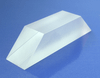
from CeNing Optics Co., Ltd.
Dove prisms can be used as an image rotator, the output image rotates through twice the angle that the prism rotates through. Dove prism also can be used as a retroreflectors. [See More]
- Surface Quality: 60-40 Scratch / Dig
- Largest Dimension: 20
- Prism Type: Dove
- Prism Material: BK7 Glass
from Newport MKS
The LPH-PIP-8 Light Pipe Homogenizer provides highly uniform or homogenized illumination. Through the process of total internal reflection, this 8 x 8 x 100 mm light pipe can transform the output of a very non-uniform light source into highly uniform or homogenized illumination. For maximum... [See More]
- Surface Quality: 60-40 Scratch / Dig; 60-40 scratch-dig
- Prism Material: BK7 Glass

from CeNing Optics Co., Ltd.
Equilateral dispersing prisms have three equal 60 °angles, and are mostly used to disperse the spectrum. [See More]
- Surface Quality: 60-40 Scratch / Dig
- Largest Dimension: 50.8
- Prism Type: Equilateral
- Prism Material: SF-11
from Newport MKS
The BRP-10-A ValuMax ® Right-Angle Prism is ideal for beam bending and retro reflection applications. It is often used instead of mirrors in applications where deformation of the reflective surface may cause a problem. The fine balance between performance and cost has been optimized, making... [See More]
- Surface Quality: 60-40 Scratch / Dig; 60-40 scratch-dig
- Prism Material: BK7 Glass
- Prism Type: Right Angle
- Surface Flatness: λ/2

from CeNing Optics Co., Ltd.
Penta prisms are used to deviate an incident beam at a 90 ° angle independent of small positional changes of the prism with respect to the beam. The image is neither inverted nor reversed. [See More]
- Surface Quality: 60-40 Scratch / Dig
- Largest Dimension: 42.2
- Prism Type: Penta
- Prism Material: BK7 Glass
from Newport MKS
The BRP-20-A ValuMax ® Right-Angle Prism is ideal for beam bending and retro reflection applications. It is often used instead of mirrors in applications where deformation of the reflective surface may cause a problem. The fine balance between performance and cost has been optimized, making... [See More]
- Surface Quality: 60-40 Scratch / Dig; 60-40 scratch-dig
- Prism Material: BK7 Glass
- Prism Type: Right Angle
- Surface Flatness: λ/2

from CeNing Optics Co., Ltd.
Rhomboid prisms are used to displace a laser beam without changing its direction. The displacement is equal to the length of the prism. [See More]
- Surface Quality: 60-40 Scratch / Dig
- Largest Dimension: 35.4
- Prism Type: Rhomboid
- Prism Material: BK7 Glass
from Newport MKS
The BRP-30-A ValuMax ® Right-Angle Prism is ideal for beam bending and retro reflection applications. It is often used instead of mirrors in applications where deformation of the reflective surface may cause a problem. The fine balance between performance and cost has been optimized, making... [See More]
- Surface Quality: 60-40 Scratch / Dig; 60-40 scratch-dig
- Prism Material: BK7 Glass
- Prism Type: Right Angle
- Surface Flatness: λ/2
from CeNing Optics Co., Ltd.
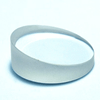
Wedge prisms are used individually to deviate a beam through some specified angles. When used in pairs, the wedge prisms can steer a beam anywhere within the circular area of each wedge. The beam steering is accomplished by rotating the two wedge prisms independently of each other. [See More]
- Surface Quality: 60-40 Scratch / Dig
- Largest Dimension: 25.4
- Prism Type: Wedge
- Prism Material: BK7 Glass

from Newport MKS
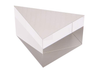
The BRP-5-A ValuMax ® Right-Angle Prism is ideal for beam bending and retro reflection applications. It is often used instead of mirrors in applications where deformation of the reflective surface may cause a problem. The fine balance between performance and cost has been optimized, making this... [See More]
- Surface Quality: 60-40 Scratch / Dig; 60-40 scratch-dig
- Prism Material: BK7 Glass
- Prism Type: Right Angle
- Surface Flatness: λ/2
from Newport MKS
The BRP-50.8-A ValuMax ® Right-Angle Prism is ideal for beam bending and retro reflection applications. It is often used instead of mirrors in applications where deformation of the reflective surface may cause a problem. The fine balance between performance and cost has been optimized, making... [See More]
- Surface Quality: 60-40 Scratch / Dig; 60-40 scratch-dig
- Prism Material: BK7 Glass
- Prism Type: Right Angle
- Surface Flatness: λ/2

from Fairfield Crystal Technology, LLC.
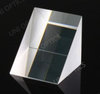
Fairfield Crystal provides component manufacturing for your most challenging designs and applications. Combined with our expertise in crystal growth our component fabrication team is able to manufacture highly polished single crystal lenses, prisms, wedges, waveplates and other optical components to... [See More]
- Surface Quality: 10-5 Scratch / Dig; 20-10 Scratch / Dig; 40-20 Scratch / Dig; 60-40 Scratch / Dig; 80-50 Scratch / Dig
- Surface Flatness: λ/2; λ/4; λ/5; λ/8; λ/10; λ/20
- Prism Type: Wedge
from UNI OPTICS(Fujian) Co., Ltd
Right Angle Prisms are typically used to bend image paths or for redirecting light at 90 °. Right Angle Prisms are Prisms designed with a 90 ° angle. Right Angle Prisms produce inverted or reverted left handed images, depending on the orientation of the prism. Using two Right Angle Prisms... [See More]
- Surface Quality: 60-40 Scratch / Dig
- Largest Dimension: 10 to 70
- Prism Type: Right Angle
- Prism Material: BK7 Glass; UV Grade Fused Silica

from Zygo Corporation
A corner cube retroreflector, also known as a CCR or trihedral prism, is an optical structure that consists of three adjacent, mutually-orthogonal plane-reflecting surfaces which form the corner of a cube. The corner cube reflects an incident ray at a specific angle, independent of the prism and... [See More]
- Surface Quality: 20-10 Scratch / Dig; 40-20 Scratch / Dig; 60-40 Scratch / Dig
- Largest Dimension: 10 to 100
- Prism Type: Corner Cube Retroreflector
- Prism Material: BK7 Glass; UV Grade Fused Silica; BK7, Fused Silica, Germanium, Silicon and more

from ECOPTIK (CHANGCHUN) LTD
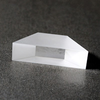
An anamorphic prism pair is a pair of prisms which is usually used for reshaping the profile of a laser beam. For example, the elliptical beam from a laser diode can be transformed into a beam with circular cross-section, as is needed for many applications, by using a prism pair as a beam expander... [See More]
- Surface Quality: 60-40 Scratch / Dig
- Prism Material: SF11
- Prism Type: Anamorphic
- Surface Flatness: λ/8
from Changchun Sunday Optics Co., Ltd.
Short pass filter allow the shorter wavelength throught, and cut off the longer wavelength.These filter mainly used in Beauty equipment, police multiband testing instruments, strong light flashlight, stage lighting shade, four-wheel, iris recognition system, face recognition attendance device,... [See More]
- Surface Quality: 10-5 Scratch / Dig; 20-10 Scratch / Dig; 40-20 Scratch / Dig; 60-40 Scratch / Dig
- Largest Dimension: 2 to 300
- Prism Type: Dove
- Prism Material: BK7 Glass; BK7, UV Fused Silica, Sapphire, ZnSe, Caf2, Si, Ge, etc.
from Daheng New Epoch Technology, Inc.
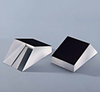
Aluminum coated with black paint for protection. [See More]
- Surface Quality: 60-40 Scratch / Dig
- Prism Material: BK7 Glass
- Largest Dimension: 34.2 to 51.3
- Surface Flatness: λ/2; λ/4

from Knight Optical (UK) Ltd
Amici Roof prisms also known as “Dach Prisms ” or “Dachkanten Prisms ” have two sections that meet at 90 °. Roof prisms rotate a beam by 90 ° and at the same time invert the beam of light. This makes the amici roof prism appropriate for use in telescope eyepieces... [See More]
- Surface Quality: 60-40 Scratch / Dig
- Largest Dimension: 15

from MOK Optics Co., Ltd.
Corner cube prisms are prisms which act as corner reflectors, a type of retroreflectors. They are often used in the context of optical metrology, e.g. in interferometers, and in spectroscopy. [See More]
- Surface Quality: 10-5 Scratch / Dig; 20-10 Scratch / Dig; 40-20 Scratch / Dig; 60-40 Scratch / Dig
- Largest Dimension: 3 to 60
- Prism Type: Corner Cube Retroreflector
- Prism Material: UV Grade Fused Silica; CDGM, SCHOTT, OHARA, HOYA, Sapphire, MgF2, CaF2, JGS3, Corning 7979 etc.
from Edmund Optics Inc.
Ideal for Beam Steering. 0.5 ° - 15 ° Beam Deviation Options. Available Uncoated or Anti-Reflection Coated. Anamorphic Prism Pair Also Available. Wedge prisms can be used individually to deviate a laser beam a set angle, or two wedge prisms can be used together for beam steering... [See More]
- Surface Quality: 60-40 Scratch / Dig
- Largest Dimension: 25
- Prism Type: Wedge
- Prism Material: BK7 Glass

from EKSMA OPTICS
These prisms (corner cube) have 3 mirror surfaces making angles of 90 ° to each other, juxtaposed to form the corner of a cube with the entrance face perpendicular to cube diagonal. All beams, despite of incident direction, are reflected back to the original direction. Solid corner cube is used... [See More]
- Surface Quality: 60-40 Scratch / Dig
- Largest Dimension: 25.4 to 38.1
- Prism Type: Corner Cube Retroreflector
- Prism Material: BK7 Glass; UV Grade Fused Silica

from HG Optronics, Inc.
Invented by H.W. Dove, Dove Prisms are also known Reversion prisms. When the prism is rotated about its length axis, the image viewed through the prism rotates at twice the prism rotation rate. This is an unusual and sometimes useful property for special applications. Entry and exit faces are... [See More]
- Surface Quality: 60-40 Scratch / Dig
- Largest Dimension: 84.5
- Prism Type: Dove
- Prism Material: BK7 Glass; UV Grade Fused Silica; N-BK7 Grade A optical glass

from Foctek Photonics, Inc.
here are many types of prism, each having a particular geometry to achieve the reflections necessary to perform a specific imaging task. Reflecting prisms may invert, rotate, deviate or displace a beam. Dispersing prisms produce spectral separation for spectroscopic online_orderings or for tuning a... [See More]
- Surface Quality: 60-40 Scratch / Dig
- Largest Dimension: 12
- Prism Type: Anamorphic
- Prism Material: N-SF11 Grade A

from Artifex Engineering
Corner Cube Prisms, which have three mutually perpendicular surfaces and a hypotenuse face, are designed to reflect any ray or beam entering the prism face back onto itself, regardless of the orientation of the prisms. A mirror will only do that at the normal angle of incidence. There are three... [See More]
- Surface Quality: 60-40 Scratch / Dig
- Largest Dimension: 72.5
- Prism Type: Corner Cube Retroreflector
- Prism Material: BK7 Glass
from Ross Optical Industries
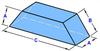
Dove prism is a truncated version of right angle prism. A beam entering parallel to the hypotenuse face is reflected internally and emerges parallel to its incident direction. Dove prisms are used as image rotators. As the prism is rotated, the image passing through will rotate at an angle twice... [See More]
- Surface Quality: 60-40 Scratch / Dig
- Largest Dimension: 5.07
- Prism Type: Dove
- Prism Material: BK7 Glass
from UNI OPTICS(Fujian) Co., Ltd
Invented by H.W. Dove, Dove Prisms are also known Reversion prisms. When the prism is rotated about its length axis, the image viewed through the prism rotates at twice the prism rotation rate. This is an unusual and sometimes useful property for special applications. Entry and exit faces are... [See More]
- Surface Quality: 60-40 Scratch / Dig
- Largest Dimension: 84.5
- Prism Type: Dove
- Prism Material: BK7 Glass

from ECOPTIK (CHANGCHUN) LTD
Dove prisms have an unusual and very interesting characteristic , if you look through the prism and rotate it around a longitudinal axis, the image rotates through twice the angle through which the dove prism itself rotates. For optimal performance, use dove prisms with collimated light. Description... [See More]
- Surface Quality: 40-20 Scratch / Dig; 60-40 Scratch / Dig
- Largest Dimension: 35.4
- Prism Type: Dove
- Prism Material: BK7 Glass; UV Grade Fused Silica

from Changchun Sunday Optics Co., Ltd.
Fluorescence Filters refer to a variety of Filters applied to a Fluorescence system, including the extraction of fluorescent energy or the acquisition of fluorescent images.Its main characteristics are good isolation degree of interference light and less spontaneous fluorescence... [See More]
- Surface Quality: 10-5 Scratch / Dig; 20-10 Scratch / Dig; 40-20 Scratch / Dig; 60-40 Scratch / Dig
- Largest Dimension: 0.5000 to 300
- Prism Type: Equilateral
- Prism Material: BK7 Glass; BK7, UV Fused Silica, Sapphire, ZnSe, Caf2, Si, Ge, etc.

from Daheng New Epoch Technology, Inc.
This type of prism is a half of a common right-angle prism with the right angle corner truncated parallel to the hypotenuse face, enters one of slope faces, has total internal reflection(TIR) on that face, and emerges from the other slope face parallel to its incident direction. Because of one... [See More]
- Surface Quality: 60-40 Scratch / Dig
- Largest Dimension: 42.28 to 82.56
- Prism Type: Dove
- Prism Material: BK7 Glass
from Knight Optical (UK) Ltd
Homogenising light pipe rods provide uniform, homogenised illumination of non-uniform light sources through the process of total internal reflection. Hexagonal light pipe homogenising rods achieve about 35-40% increase on output of light compared to conventional square cross sections types. We offer... [See More]
- Surface Quality: 60-40 Scratch / Dig
- Surface Flatness: λ/4
- Largest Dimension: 2
from MOK Optics Co., Ltd.
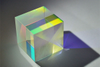
X cube prism is cemented by 4pcs right angle prism with non-polarization / polarization beamsplitter coating [See More]
- Surface Quality: 10-5 Scratch / Dig; 20-10 Scratch / Dig; 40-20 Scratch / Dig; 60-40 Scratch / Dig
- Prism Material: UV Grade Fused Silica; CDGM, SCHOTT, OHARA, HOYA, Sapphire, MgF2, CaF2, JGS3, Corning 7979 etc.
- Largest Dimension: 3 to 200
- Coating Options: Reflective Coating (optional feature); Antireflection Coating (optional feature)

from HG Optronics, Inc.
In optics, a prism is a transparent optical element with flat, polished surfaces that refract light. At least two of the flat surfaces must have an angle between them. The exact angles between the surfaces depend on the application. The traditional geometrical shape is that of a triangular prism... [See More]
- Surface Quality: 10-5 Scratch / Dig; 60-40 Scratch / Dig
- Largest Dimension: 70
- Prism Type: Right Angle
- Prism Material: BK7 Glass; UV Grade Fused Silica; N-BK7 glass , UV Fused silica, other optical glass

from Foctek Photonics, Inc.
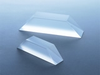
This special prism consists of one Right Angle prism and one Rhomboid Prism. The hypotenuse surface of the Right Angle Prism is beam-splitting coated and cemented to the Rhomboid Prism. The two split output beams are parallel to each other, and perpendicular to the input beam at high accurate. [See More]
- Surface Quality: 60-40 Scratch / Dig
- Prism Material: BK7 Glass; SF10 Glass; Fused Silica, MgF2
- Largest Dimension: 2 to 50
- Coating Options: Reflective Coating (optional feature); Antireflection Coating (optional feature)
from Artifex Engineering
The Dove Prism is a form invented by H.W. Dove. It resembles half of a common right angle prism in which a ray entering parallel to the hypotenuse face is reflected internally at that face and emerges parallel to its incident direction. If the prism is rotated about the optical axis, the image is... [See More]
- Surface Quality: 60-40 Scratch / Dig
- Largest Dimension: 80
- Prism Type: Dove
- Prism Material: BK7 Glass

from Ross Optical Industries
These prisms have three equal 60 ° angles and are used as dispersing prisms. [See More]
- Surface Quality: 60-40 Scratch / Dig
- Largest Dimension: 25
- Prism Type: Equilateral
- Prism Material: Crown Glass

from UNI OPTICS(Fujian) Co., Ltd
The Anamorphic prisms are used in pairs to magnify input beam size along one axis while leaving the other axis unchanged. The elliptical laser diode beams can be transferred into nearly circular. [See More]
- Surface Quality: 60-40 Scratch / Dig
- Prism Material: N-SF11
- Prism Type: Anamorphic
- Surface Flatness: λ/8
from ECOPTIK (CHANGCHUN) LTD
Prisms: Right angle prism, Dove prism, Beam splitter, Penta Prism, Corner prism, Trapezium Prism, Rhomboid Prism, Roof Prism, Cube prism, customized prisms, etc. [See More]
- Surface Quality: 10-5 Scratch / Dig; 20-10 Scratch / Dig; 40-20 Scratch / Dig; 60-40 Scratch / Dig; 80-50 Scratch / Dig
- Surface Flatness: λ/2; λ/4; λ/5; λ/8; λ/10
- Prism Type: Dove; Penta; Right Angle; Roof; Beam splitter, Corner prism, Trapezium Prism, Rhomboid Prism, Cube prism, customized prisms, etc..
from Changchun Sunday Optics Co., Ltd.
A polarizing prism can divide incident unpolarized light into two perpendicular lines. Where, P polarized light passes through completely, while S polarized light is reflected at an Angle of 45 degrees, and the exit direction is 90 degrees with P light. The polarization splitting prism is composed... [See More]
- Surface Quality: 10-5 Scratch / Dig; 20-10 Scratch / Dig; 40-20 Scratch / Dig; 60-40 Scratch / Dig
- Largest Dimension: 0.5000 to 300
- Prism Type: Littrow Prism
- Prism Material: BK7 Glass; BK7, UV Fused Silica, Sapphire, ZnSe, Caf2, Si, Ge, etc.

from Daheng New Epoch Technology, Inc.
An equilateral dispersing prism has an equilateral triangle in the cross-section with the three sides of equal length. They are used for wavelength separation. A light ray is refracted twice, passing through the prism with total deviation denoted by qd top angle. Deviation is a function of... [See More]
- Surface Quality: 60-40 Scratch / Dig
- Largest Dimension: 10 to 40
- Prism Type: Equilateral
- Prism Material: SF10 Glass

from HG Optronics, Inc.
Beamsplitter Penta Prism by adding a wedge and with partial reflective coating on one of its leaning surfaces, Penta Prism can be used as Beamsplitter. Transmission/reflection (T/R) ratio of 50/50, or others for Beamsplitter Penta Prism is available upon request. 4.1.What is beamsplitter penta prism... [See More]
- Surface Quality: 40-20 Scratch / Dig; 60-40 Scratch / Dig
- Largest Dimension: 42
- Prism Type: Penta
- Prism Material: BK7 Glass; UV Grade Fused Silica; N-BK7, Grade A optical glass, Fused silica

from Foctek Photonics, Inc.
By adding a wedge and with partial reflective coating on first reflective surface, Penta Prism can be used as Beamsplitter. We supply Beamsplitter Penta Prism with standard Transmission/reflection (T/R) ratio of 20/80,50/50. Other T/R ratio is available upon request. [See More]
- Surface Quality: 60-40 Scratch / Dig
- Largest Dimension: 7 to 20
- Prism Type: Penta
- Prism Material: BK7 Glass
from Artifex Engineering
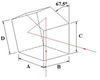
The penta prism is a five-sided prism. It reflects light rays through a 90 ° angle by two reflections and does not invert or revert the image. The reflecting surfaces are aluminized. Slight movement of the prism does not affect the true right angle at which light rays are reflected. The penta... [See More]
- Surface Quality: 60-40 Scratch / Dig
- Largest Dimension: 43.3
- Prism Type: Penta
- Prism Material: BK7 Glass
from Ross Optical Industries
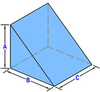
Right angle prisms are optical elements having at least three polished faces inclined relative to each other at 45-90-45 degrees. They can be used as total internal reflectors, hypotenuse face reflectors, retroreflectors and 90 degrees beam benders. [See More]
- Surface Quality: 60-40 Scratch / Dig
- Largest Dimension: 1.5
- Prism Type: Right Angle
- Prism Material: BK7 Glass
from UNI OPTICS(Fujian) Co., Ltd
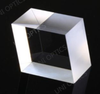
The Rhomboid prism application for rhomboid-prism is controlling and redirecting the optical path without affecting the image direction. They can be used to displace an optical center line for light beam folding and stereoscopic systems of different sizes. [See More]
- Surface Quality: 60-40 Scratch / Dig
- Largest Dimension: 25
- Prism Type: Rhomboid
- Prism Material: BK7 Glass

from ECOPTIK (CHANGCHUN) LTD
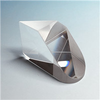
1, Non-uniform light source can be homogenized.2, The pupil is octagon.3, Can be used to build lighting systems. Description Of Octagon Based Prism Octagonal light guide rod adopts total reflection, which can transform non-uniform light source into uniform light. Regular octagonal optical prism also... [See More]
- Surface Quality: 60-40 Scratch / Dig
- Prism Material: BK7 Glass; UV Grade Fused Silica
- Prism Type: Octagon Rod
- Surface Flatness: λ/2
from Changchun Sunday Optics Co., Ltd.
Dove prism is a kind of reflection prism used for image reflection.Dove prisms are formed by truncated rectangular prisms.A beam of light enters one of the slanted faces of the prism, fully reflects from inside the longest (bottom) face, and then exits from the opposite slanted face.The image... [See More]
- Surface Quality: 10-5 Scratch / Dig; 20-10 Scratch / Dig; 40-20 Scratch / Dig; 60-40 Scratch / Dig
- Largest Dimension: 3 to 300
- Prism Type: Roof
- Prism Material: BK7 Glass; BK7, UV Fused Silica, Sapphire, ZnSe, Caf2, Si, Ge, etc.

from Daheng New Epoch Technology, Inc.
Fused Silica is regarded as very good material to be used in UV laser and imaging applications. It has high transmission from 200nm to 2.5um. In addition, it also can be used in higher operating temperatures. Right angle often used, instead of mirrors, in applications where deformation of the... [See More]
- Surface Quality: 60-40 Scratch / Dig
- Largest Dimension: 10 to 24.5
- Prism Type: Right Angle
- Prism Material: UV Grade Fused Silica

from HG Optronics, Inc.
Wedge prism is an optical element with plane-inclined surfaces, usually the faces are inclined toward one another at a very small angles. It diverts light toward its thicker portion. Wedge prisms can be used as isolating components. Wedges may also be used to produce a small deviation which doesnt... [See More]
- Surface Quality: 60-40 Scratch / Dig
- Largest Dimension: 25.4
- Prism Type: Wedge
- Prism Material: BK7 Glass; UV Grade Fused Silica; N-BK7, Grade A optical glass, Fused silica

from Foctek Photonics, Inc.
There are many types of prism, each having a particular geometry to achieve the reflections necessary to perform a specific imaging task. Reflecting prisms may invert, rotate, deviate or displace a beam. Dispersing prisms produce spectral separation for spectroscopic online_orderings or for tuning a... [See More]
- Surface Quality: 60-40 Scratch / Dig
- Largest Dimension: 15 to 50.8
- Prism Type: Corner Cube Retroreflector
- Prism Material: BK7 Glass
from Artifex Engineering
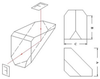
We offer a wide variety of standard prisms for reflection, deviation and image manipulation. Here you will find our standard prisms. We have the manufacturing capability to realize any other prism design. Contact us to discuss your requirements. [See More]
- Surface Quality: 60-40 Scratch / Dig
- Largest Dimension: 41.1
- Prism Type: Roof
- Prism Material: BK7 Glass
from Ross Optical Industries
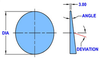
These prisms are usually round and have two flat sides that are at a small angle to each other. They are used for beam steering in laser applications. The wedge angle determines the amount of the beam deviation. [See More]
- Surface Quality: 60-40 Scratch / Dig
- Largest Dimension: 12.7
- Prism Type: Wedge
- Prism Material: BK7 Glass

from UNI OPTICS(Fujian) Co., Ltd
Beamsplitter Penta Prism by adding a wedge and with partial reflective coating on one of its leaning surfaces, Penta Prism can be used as Beamsplitter. Transmission/reflection (T/R) ratio of 50/50, or others for Beamsplitter Penta Prism is available upon request. [See More]
- Surface Quality: 60-40 Scratch / Dig
- Largest Dimension: 30 to 42.42
- Prism Type: Penta
- Prism Material: F2 Glass

from ECOPTIK (CHANGCHUN) LTD
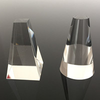
Prism, a transparent object surrounded by two planes that intersect but are not parallel to each other, used to split light or disperse light beams. A prism is a polyhedron made of transparent materials (such as glass, crystal, etc.). It is widely used in optical instruments. Prisms can be divided... [See More]
- Surface Quality: 10-5 Scratch / Dig; 20-10 Scratch / Dig; 40-20 Scratch / Dig; 60-40 Scratch / Dig; 80-50 Scratch / Dig
- Surface Flatness: λ/2; λ/4; λ/5; λ/8; λ/10
- Prism Type: Dove; Penta; Right Angle; Roof; Beam splitter, Corner prism, Trapezium Prism, Rhomboid Prism, Cube prism, customized prisms, etc..
from Changchun Sunday Optics Co., Ltd.
Equilateral prism is one kind of dispersion prism. It has three equal 60deg angles and it can separate a beam of white light into its component colors. Equilateral prism is always used for wavelength separating applications and spectrum analysis. [See More]
- Surface Quality: 10-5 Scratch / Dig; 20-10 Scratch / Dig; 40-20 Scratch / Dig; 60-40 Scratch / Dig
- Largest Dimension: 0.5000 to 300
- Prism Type: Solar Engery Prism
- Prism Material: BK7 Glass; BK7, UV Fused Silica, or customer request.

from Daheng New Epoch Technology, Inc.
A Penta prisms is a five-side prisms, featuring two important properties. Firstly, the images is neither inverted nor reversed while it is deviated by 90 degree. Secondly, it is a constant deflection device, i.e., all the transmitted rays are exactly deflected by 90 degree. Slight movement of the... [See More]
- Surface Quality: 60-40 Scratch / Dig
- Largest Dimension: 21.6 to 43.3
- Prism Type: Penta
- Prism Material: BK7 Glass

from HG Optronics, Inc.
Corner Cube Prism also called Retroreflector.It has three mutually perpendicular surfaces and a hypotenuse face. Light entering through the hypotenuse is reflected by each of the three surfaces in turn and will emerge through the hypotenuse face parallel to the entering beam regardless of the... [See More]
- Surface Quality: 10-5 Scratch / Dig; 60-40 Scratch / Dig
- Largest Dimension: 72.52
- Prism Type: Corner Cube Retroreflector
- Prism Material: BK7 Glass; UV Grade Fused Silica; N-BK7 glass , UV Fused silica or other optical glasses.

from Foctek Photonics, Inc.
Besides the Reflection Prisms, Foctek also offers the Dispersion Prisms. The most typical dispersion prism is equilateral prism made of high difference of refraction indexes for different wavelengths. The dispersion prisms of special use are: Litrow prisms, Pellin-Broca prisms, Brewster prisms,... [See More]
- Surface Quality: 60-40 Scratch / Dig
- Prism Material: BK7 Glass; N-BK7, Fused Silica, MgF2, N-SF10
- Prism Type: Equilateral; Isoscele, Littrow, Pellin - Broca, Brewster, Amici
- Coating Options: Reflective Coating (optional feature); Antireflection Coating (optional feature)

from UNI OPTICS(Fujian) Co., Ltd
Wedge prism is an optical element with plane-inclined surfaces, usually the faces are inclined toward one another at a very small angles. It diverts light toward its thicker portion. Wedge prisms can be used as isolating components. Wedges may also be used to produce a small deviation which doesnt... [See More]
- Surface Quality: 60-40 Scratch / Dig
- Largest Dimension: 25.4
- Prism Type: Wedge
- Prism Material: BK7 Glass

from ECOPTIK (CHANGCHUN) LTD
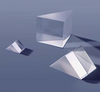
The Powell lens is a quantum leap forward in line generator performance over the simple cylinder lens. A cylinder lens produces a poorly illuminated line, one limited by the non-uniform, Gaussian laser beam. The Powell lens' rounded roof is in fact a complex two-dimensional aspheric curve that... [See More]
- Surface Quality: 20-10 Scratch / Dig; 40-20 Scratch / Dig; 60-40 Scratch / Dig
- Largest Dimension: 15
- Prism Type: Powell
- Prism Material: BK7 Glass; Fused Silica
from Daheng New Epoch Technology, Inc.
Right angle prisms are ideal for beam bending and retro reflection applications. They are often used, instead of mirrors, in applications where deformation of the reflective surface may cause a problem. The fine balance between performance and cost has been optimized making these prisms ideal for... [See More]
- Surface Quality: 60-40 Scratch / Dig
- Largest Dimension: 5 to 50.8
- Prism Type: Right Angle
- Prism Material: BK7 Glass

from HG Optronics, Inc.
Penta Prisms are used to define right angles in optical systems. Penta Prisms, which provide right handed images,feature a ray deviation of 90 °. Penta Prisms are five-sided prisms are unaffected by slight movements. HG OPTRONICS offers a variety of Penta Prisms for optimal performance in the... [See More]
- Surface Quality: 40-20 Scratch / Dig; 60-40 Scratch / Dig
- Largest Dimension: 42.42
- Prism Type: Penta
- Prism Material: BK7 Glass; UV Grade Fused Silica; N-BK7, Grade A optical glass, Fused Silica

from Foctek Photonics, Inc.
here are many types of prism, each having a particular geometry to achieve the reflections necessary to perform a specific imaging task. Reflecting prisms may invert, rotate, deviate or displace a beam. Dispersing prisms produce spectral separation for spectroscopic online_orderings or for tuning a... [See More]
- Surface Quality: 60-40 Scratch / Dig
- Largest Dimension: 21.1 to 63.4
- Prism Type: Dove
- Prism Material: BK7 Glass

from UNI OPTICS(Fujian) Co., Ltd
Corner Cube Prism also called Retroreflector. It has three mutually perpendicular surfaces and a hypotenuse face. Light entering through the hypotenuse is reflected by each of the three surfaces in turn and will emerge through the hypotenuse face parallel to the entering beam regardless of the... [See More]
- Surface Quality: 60-40 Scratch / Dig
- Largest Dimension: 72.52
- Prism Type: Corner Cube Retroreflector
- Prism Material: BK7 Glass

from ECOPTIK (CHANGCHUN) LTD
A pyramidal prism/angular cube reflector is always used to reflect a beam of light into the prism, regardless of the direction of the beam. Corner prisms are widely used where accurate alignment is difficult. Corner prism rear reflector/pyramid prism is designed to reflect any light or beam entering... [See More]
- Surface Quality: 60-40 Scratch / Dig
- Prism Material: BK7 Glass; UV Grade Fused Silica
- Prism Type: Corner Cube Retroreflector
- Surface Flatness: λ/4

from Daheng New Epoch Technology, Inc.
This type of prism consists of a roof edge produced upon the long reflecting face of a right-angle prism and is also called Amici roof prism. Like a right-angle prism, it reflects an image by 90°, but inverts the image simultaneously. It is commonly used as an erecting system in telescopes. [See More]
- Surface Quality: 60-40 Scratch / Dig
- Largest Dimension: 24.5 to 41
- Prism Type: Right Angle; Roof
- Prism Material: BK7 Glass

from Foctek Photonics, Inc.
This special Beam Splitter is made of two special designed prisms. The cemented surface of one prism is beam splitter coating. The Prism enables splitting beam of light per two beams parallel to each other, and parallel to the input beam with high accurate. The distance between two output beams can... [See More]
- Surface Quality: 60-40 Scratch / Dig
- Prism Material: BK7 Glass; SF10 Glass; Fused Silica, MgF2
- Largest Dimension: 2 to 50
- Coating Options: Reflective Coating (optional feature); Antireflection Coating (optional feature)
from UNI OPTICS(Fujian) Co., Ltd
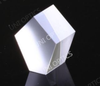
Penta Prisms are used to define right angles in optical systems. Penta Prisms, which provide right handed images,feature a ray deviation of 90 °. Penta Prisms are five-sided prisms are unaffected by slight movements. Uni Optics offers a variety of Penta Prisms for optimal performance in the... [See More]
- Surface Quality: 60-40 Scratch / Dig
- Largest Dimension: 30 to 42.42
- Prism Type: Penta
- Prism Material: BK7 Glass

from ECOPTIK (CHANGCHUN) LTD
Rhombic prisms are used to displace a beam laterally without changing its direction. They may be coated to transmit part of the beam and produce two parallel and displaced emerging beams. Can be coated to produce a polarizing beam separator. These prisms are manufactured from either BK7A or Fused... [See More]
- Surface Quality: 20-10 Scratch / Dig; 40-20 Scratch / Dig; 60-40 Scratch / Dig
- Prism Material: BK7 Glass; UV Grade Fused Silica

from Daheng New Epoch Technology, Inc.
An optical element has plane-inclined surface. Wedge prisms are used as small beam steering elements in optical systems. By combining two wedges of equal power (equal wedge angle) in near contact and independently rotating them, a ray passing through the combination can be steered in any direction... [See More]
- Surface Quality: 60-40 Scratch / Dig
- Largest Dimension: 25.4 to 38.1
- Prism Type: Wedge
- Prism Material: BK7 Glass

from Foctek Photonics, Inc.
This special Beam Splitter is made of two special designed prisms. The cemented surface of one prism is beam splitter coating. The Prism enables splitting beam of light per two beams parallel to each other, and parallel to the input beam with high accurate. The distance between two output beams can... [See More]
- Surface Quality: 60-40 Scratch / Dig
- Prism Material: BK7 Glass; SF10 Glass; Fused Silica, MgF2
- Largest Dimension: 2 to 50
- Coating Options: Reflective Coating (optional feature); Antireflection Coating (optional feature)

from ECOPTIK (CHANGCHUN) LTD
Right angle prisms are extremely versatile optical components, commonly used as individual prisms and components of optical assemblies. A beam of light entering the leg of a right angle prism will deviate by a nominal value of 90 °, while precise rotation of the prism controls beam alignment. [See More]
- Surface Quality: 20-10 Scratch / Dig; 40-20 Scratch / Dig; 60-40 Scratch / Dig
- Largest Dimension: 200
- Prism Type: Right Angle
- Prism Material: BK7 Glass; UV Grade Fused Silica

from Foctek Photonics, Inc.
Penta prism can deviate an incident beam without inverting or reversing to 90 °.The deviation angle of 90 ° is independent of any rotation of the prism about an axis parallel to the line of intersection of the two reflecting faces. It is commonly used in Plumb Level, Surveying, Alignment,... [See More]
- Surface Quality: 60-40 Scratch / Dig
- Largest Dimension: 2.5 to 100
- Prism Type: Penta
- Prism Material: BK7 Glass

from ECOPTIK (CHANGCHUN) LTD
BRD Optical offers wedge prism: Right angle prism, Dove prism, Beam splitter, Penta Prism, Corner prism, Trapezium Prism, Rhomboid Prism, Roof Prism, Cube prism, customized prisms, etc. [See More]
- Surface Quality: 20-10 Scratch / Dig; 40-20 Scratch / Dig; 60-40 Scratch / Dig
- Prism Material: BK7 Glass; UV Grade Fused Silica
- Prism Type: Wedge
- Surface Flatness: λ/8

from Foctek Photonics, Inc.
There are many types of prism, each having a particular geometry to achieve the reflections necessary to perform a specific imaging task. Reflecting prisms may invert, rotate, deviate or displace a beam. Dispersing prisms produce spectral separation for spectroscopic online_orderings or for tuning a... [See More]
- Surface Quality: 10-5 Scratch / Dig; 60-40 Scratch / Dig
- Largest Dimension: 1 to 300
- Prism Type: Right Angle
- Prism Material: UV Grade Fused Silica

from ECOPTIK (CHANGCHUN) LTD
This is a custom optical product. It combines optical wedge, window and spherical lens. [See More]
- Surface Quality: 60-40 Scratch / Dig
- Prism Material: Corning 7980 / Schott KG2
- Prism Type: Wedge
- Coating Options: Antireflection Coating