
Burn-in Automated Test Equipment
Description
Burn-in Automated Test Equipment is designed to screen or eliminate marginal electronic devices by subjecting them to stress conditions. This equipment operates electronic components or systems under specific electrical and thermal conditions to accelerate their aging process, effectively simulating real-life usage in a compressed timeframe.
Working Principle
Burn-in testing works by exposing components to extreme operating conditions, such as high temperatures, high-use cycles, and high voltages. This process is aimed at detecting early failures in components, thereby reducing the potential for defects and failures in the field. By accelerating the aging process, burn-in testing helps in identifying components that are likely to fail early, ensuring that only robust devices reach the market.
Applications
Burn-in Automated Test Equipment is crucial in industries where reliability is paramount. For instance, in the medical and military sectors, where devices often operate in extreme environments, burn-in testing ensures that only components capable of withstanding such conditions are deployed. This testing is also vital in the semiconductor industry to ensure the reliability of chips used in various electronic devices.
Advantages over other Automated Test Equipment
Burn-in testing offers the advantage of detecting early failures that might not be apparent under normal testing conditions. Unlike Environmental Stress Screening (ESS), which involves temperature cycling and random vibration, burn-in testing provides a more focused approach by maintaining components at a constant high temperature, which can be more effective in identifying thermal-related failures.
Limitations
One limitation of burn-in testing is its lengthy process, which can be time-consuming compared to other testing methods like ESS. Additionally, the constant high-temperature conditions required for burn-in testing can lead to increased energy consumption and operational costs.
Considerations
When considering burn-in Automated Test Equipment, it is important to evaluate the initial costs, which can be significant due to the complexity of the equipment. Operating expenses are also a factor, as the process requires sustained energy input to maintain high temperatures. Durability and accuracy are critical, as the equipment must reliably simulate real-life conditions without introducing additional variables. Replacement and maintenance costs should also be considered, as the equipment may require regular calibration and servicing to ensure optimal performance.

from ESPEC North America Inc | Qualmark Products and Services
The ESS22/35 Series offers high volume horizontal airflow for rack systems. The chambers can be adapted to many product configurations and provide manual, automatic robotic interface. A variety of methods are available for product power and test interface including auto insertion. Provides fast... [See More]
- Features: Burn-In or Temperature Control; Temperature Control / Oven
- Component / Product Tested: Semiconductors or Active Components
- Type / Form: Module, Sub-system or ATE Component; Test Chamber
- Tester / Test Capability: Environmental Stress Test Chamber

from ESPEC North America Inc | Qualmark Products and Services
Environmental stress screening (ESS) is also known as Burn-in, AST (Accelerated Stress Testing), HALT (Highly Accelerated Stress Test), or HASS (Highly Accelerated Stress Screening). Whatever the name, the idea is the same: create a test program that allows you to eliminate the infant mortality of... [See More]
- Features: Burn-In or Temperature Control; Temperature Control / Oven
- Component / Product Tested: Semiconductors or Active Components
- Type / Form: Module, Sub-system or ATE Component; Test Chamber
- Tester / Test Capability: Environmental Stress Test Chamber
from Intepro Systems
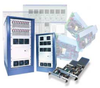
Energy Recycling Air Cooled AC & DC Loads. Intepro's electronic loads are ideal where high power bulk loading is required for burn-in and characterisation applications within Telecommunication and Aerospace sectors, Intepro ’s environmental stress screening (ESS)/Burn-in solutions... [See More]
- Features: Burn-In or Temperature Control; I-V
- Component / Product Tested: Power Supplies or Transformers; Networking or Communications Equipment
- Type / Form: Platform or Turnkey System; Load Bank or Electronic Load; CAD Interface, Database, Test Program Generator or Other Test Software
- Tester / Test Capability: Life or Endurance Test
from CHINO Works America Inc.
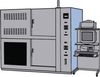
The equipment is semiconductor aging testing equipment to full-automatically execute burn-in processing and data measurement/judgment/analytical processing and also has tester function as well as temperature accelerating testing. [See More]
- Features: Burn-In or Temperature Control; Diagnostics; Temperature Control / Oven
- Component / Product Tested: MEMS or Electromechanical Devices; Passive Components; Loaded PCBs; Power Supplies or Transformers; Optoelectronics; Semiconductors or Active Components
- Type / Form: Platform or Turnkey System; Output Measurement or Monitoring Unit; Input Stimulus or Signal Source Unit; Fixture / Interface
- Tester / Test Capability: Life or Endurance Test; Functional

from Artifex Engineering
The LIV120 is a powerful but low cost CW / QCW test sy stem for use in the lab as well as for OEM applications, ideal for. Burn-in Test Equipment. Diode characterization. Quality control of incoming goods. OEM. We offer this instrument with a variety of end stages covering current ranges up to 2A in... [See More]
- Features: Burn-In or Temperature Control
- Component / Product Tested: Laser Diodes
- Type / Form: Module, Sub-system or ATE Component; Output Measurement or Monitoring Unit