
Load Bank / Electronic Load Automated Test Equipment
Description
Load banks and electronic loads are devices used to simulate electrical loads for testing power sources. They are essential tools in evaluating the performance, stability, and efficiency of various power systems by drawing controlled current, voltage, or power from the source under test.
Working Principle
Electronic load banks operate by using transistors to simulate ohmic resistance, allowing them to sink power effectively. They are fully programmable and can dynamically simulate changing load profiles such as constant voltage (CV), constant current (CC), constant power (CP), and constant resistance (CR). This capability makes them useful for performing long-term burn-in tests and step changes in power, enhancing the quality of testing for DC voltage and current sources like batteries, power supplies, capacitors, or turbines .
Applications
Electronic loads and load banks are used across various industries for specific applications. They are employed in design verification, production testing, and troubleshooting of devices such as AC and DC power supplies, switching power supplies, and uninterruptible power supplies (UPS). They are also used for testing fuel cells, inverters, telecommunications rectifiers, batteries, and battery chargers . In industries like hospitals, aeronautics, transport, telecom, and mining, electronic load banks are preferred for their precision and reliability .
Advantages over other Automated Test Equipment
Electronic load banks offer several advantages over other types of automated test equipment. They are more precise and sophisticated, allowing for full programmability and automation, which is beneficial for efficient and continual use . Unlike fixed value load banks, electronic loads can perform complex testing requirements by dynamically simulating various load profiles, which is crucial for testing DC voltage and current sources .
Limitations
One limitation of electronic load banks is their initial cost, which can be higher compared to reactive load banks . Additionally, while they offer precision and programmability, they may not be the best choice if noise, workspace, and efficiency are significant concerns for the application .
Considerations
When selecting an electronic load, it is important to consider the initial costs, operating expenses, and the specific testing requirements of your project. Durability and accuracy are critical factors, as well as the replacement and maintenance costs associated with the equipment. It is advisable to explore available options and choose a solution that offers the best mix of value and functionality while meeting your budget and project needs .
from Intepro Systems
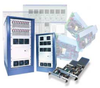
Intepro 9000 is the next generation power supply test. system from Intepro. It is fast, accurate and will cut. your test times dramatically. The modular system has. a high degree of flexibility and is capable of being. configured into highly economic systems for advanced. power electronic test. [See More]
- Type / Form: Platform or Turnkey System; Load Bank or Electronic Load; CAD Interface, Database, Test Program Generator or Other Test Software
- Tester / Test Capability: Functional
- Component / Product Tested: Power Supplies or Transformers
- Interface: Probe Card or Performance Board
from Intepro Systems
Energy Recycling Air Cooled AC & DC Loads. Intepro's electronic loads are ideal where high power bulk loading is required for burn-in and characterisation applications within Telecommunication and Aerospace sectors, Intepro ’s environmental stress screening (ESS)/Burn-in solutions... [See More]
- Type / Form: Platform or Turnkey System; Load Bank or Electronic Load; CAD Interface, Database, Test Program Generator or Other Test Software
- Tester / Test Capability: Life or Endurance Test
- Component / Product Tested: Power Supplies or Transformers; Networking or Communications Equipment
- Features: Burn-In or Temperature Control; I-V