In parallel with developments in adaptive nonlinear control, there has been a tremendous amount of activity in neural control and adaptive fuzzy approaches. In these studies, neural networks or fuzzy approximators are used to approximate unknown nonlinearities. The input/output response of the approximator is modified by adjusting the values of certain parameters, usually referred to as weights. From a mathematical control perspective, neural networks and fuzzy approximators represent just two classes of function approximators. Polynomials, splines, radial basis functions, and wavelets are examples of other function approximators that can be used and have been used in a similar setting. We refer to such approximation models with adaptivity features as adaptive approximators, and control methodologies that are based on them as adaptive approximation based control. Adaptive approximation based control encompasses a variety of methods that appear in the literature: intelligent control, neural control, adaptive fuzzy control, memory-based control, knowledge-based control, adaptive nonlinear control, and adaptive linear control. |
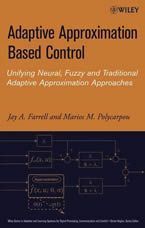 During the last few years there have been significant developments in the control of highly uncertain, nonlinear dynamical systems. For systems with parametric uncertainty, adaptive nonlinear control has evolved as a powerful methodology leading to global stability and tracking results for a class of nonlinear systems. Advances in geometric nonlinear control theory, in conjunction with the development and refinement of new techniques, such as the backstepping procedure and tuning functions, have brought about the design of control systems with proven stability properties. In addition, there has been a lot of research activity on robust nonlinear control design methods, such as sliding mode control, Lyapunov redesign method, nonlinear damping, and adaptive bounding control. These techniques are based on the assumption that the uncertainty in the nonlinear functions is within some known, or partially known, bounding functions.
 TABLE OF CONTENTS
 Chapter 5.1.1 - Linearizing Around an Equilibrium Point
5.1.1 Linearizing Around an Equilibrium Point If the nonlinear system of (5.1) is linearized around (x, u) = (0, 0) then the linear model is described by
where the matrices A ∈
If we assume that the pair (A, B) is stabilizable [10, 19, 39], then there exists a matrix K ∈
Since all the eigenvalues of A + BK are in the left-half complex plane, x(t) will converge to zero asymptotically (exponentially fast). Now, if the control law u = Kx is applied to the nonlinear system (5.1) then the closed-loop dynamics are
Linearization of (5.4) around x = 0 yields
Therefore, the linear control law u = Kx not only makes the linear model asymptotically stable but also makes the equilibrium point x = 0 of the nonlinear system asymptotically stable. Unfortunately, in the case of the nonlinear system, the asymptotic stability is only local. This implies that if the initial condition x(0) is sufficiently close to x = 0 then there is asymptotic convergence of x(t) to zero; if not, then the trajectory may not converge to zero. In fact, it may also become unbounded. If the nonlinear system has an output function then we can proceed to obtain the C and D matrices as well. Specifically, consider the system  where h(x,u) is continuously differentiable in the domain Dx× Du⊂
where A, B are given by (5.3), while C ∈
Assuming (A, B), is stabilizable and (A, C) is detectable, then based on the linear model one can design a linear dynamic output feedback controller to achieve regulation. An observer-based controller is an example of such an approach [134, 159, 279]. It is interesting to note that, similar to adaptive approximation based control, linear control is also based on an approximation, albeit a very simple one: a linear function, which is accurate only in a small neighborhood of an operating point. The basic idea behind approximation based control using nonlinear models is to expand the region where the approximation is valid from a small neighborhood around the linearizing point (in the case of linear models) to an expanded region D, where D can be relatively large (i.e., defining the state space region of possible operation). It should be noted, however, that similar to linear control methods, if the state trajectories move outside the approximating region D, then the approximation-based controller may not be effective in achieving the desired control objectives. Methods to ensure that the state trajectory remains in the region D will be an important topic in Chapters 6 and 7. ■ EXAMPLE 5.1 Consider the third-order nonlinear system  It can be readily verified that x* = [0 0 0]T, u* = 0 is an equilibrium point of the nonlinear system. Linearizing the system around the equilibrium point x = x*, u = u* gives   Suppose the control objective is to achieve regulation of y with the closed-loop poles located at s = –1 ± j and s = 2. Hence the desired characteristic equation is  This can be achieved by selecting the control law as  If the same linear control law is applied to the nonlinear system then we obtain the following closed-loop nonlinear dynamics:  Linearization of the above closed-loop system (5.7)-(5.9) yields
|

 n x n and B ∈