In parallel with developments in adaptive nonlinear control, there has been a tremendous amount of activity in neural control and adaptive fuzzy approaches. In these studies, neural networks or fuzzy approximators are used to approximate unknown nonlinearities. The input/output response of the approximator is modified by adjusting the values of certain parameters, usually referred to as weights. From a mathematical control perspective, neural networks and fuzzy approximators represent just two classes of function approximators. Polynomials, splines, radial basis functions, and wavelets are examples of other function approximators that can be used and have been used in a similar setting. We refer to such approximation models with adaptivity features as adaptive approximators, and control methodologies that are based on them as adaptive approximation based control. Adaptive approximation based control encompasses a variety of methods that appear in the literature: intelligent control, neural control, adaptive fuzzy control, memory-based control, knowledge-based control, adaptive nonlinear control, and adaptive linear control. |
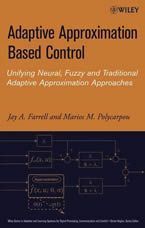 During the last few years there have been significant developments in the control of highly uncertain, nonlinear dynamical systems. For systems with parametric uncertainty, adaptive nonlinear control has evolved as a powerful methodology leading to global stability and tracking results for a class of nonlinear systems. Advances in geometric nonlinear control theory, in conjunction with the development and refinement of new techniques, such as the backstepping procedure and tuning functions, have brought about the design of control systems with proven stability properties. In addition, there has been a lot of research activity on robust nonlinear control design methods, such as sliding mode control, Lyapunov redesign method, nonlinear damping, and adaptive bounding control. These techniques are based on the assumption that the uncertainty in the nonlinear functions is within some known, or partially known, bounding functions.
 TABLE OF CONTENTS
 Chapter 5.4 - Robust Nonlinear Control Methods
In the previous three sections of this chapter we have examined three methods for controlling nonlinear systems, namely small-signal linearization, feedback linearization, and backstepping. The methodologies developed were based on the key assumption that the control designer exactly knows the system nonlinearities. In practice, this is not a realistic assumption. Consequently, it is important to consider ways to make these approaches more robust with respect to modeling errors. In this section we introduce a set of nonlinear control design tools that are based on the principle of assuming that the unknown component of the nonlinearities are bounded in some way by a known function. If this assumption is satisfied then it is possible to derive nonlinear control schemes that utilize these known bounding functions instead of the unknown nonlinearities. Although these techniques have been extensively studied in the nonlinear control literature, they tend to yield conservative control laws, especially in cases where the uncertainty is significant. The term "conservative" is used among control engineers to indicate the fact that due to the uncertainty the control effort applied is more than needed. As a result, the control signal u(t) may be large (high-gain feedback), which may cause several problems, such as saturation of the actuators, large error in the presence of measurement noise, excitation of unmodeled dynamics, and large transient errors. Furthermore, as we will see, these techniques typically involve a switching control function, which may cause chattering. The robust nonlinear control design methods developed in this section provide an important perspective for the adaptive approximation based control described in Chapters 6 and 7. Specifically, adaptive approximation based control can be viewed as a way of reducing uncertainty during operation such that the need for conservative robust control can be eliminated or reduced. Another reason for studying these techniques in the context of adaptive approximation is their utilization, as we will see, to guarantee closed-loop stability outside of the approximation region D. This section presents five nonlinear control design tools: (i) bounding control, (ii) sliding mode control, (iii) Lyapunov redesign method, (iv) nonlinear damping, and (v) adaptive bounding. As we will see, these techniques are, in fact, quite similar. |