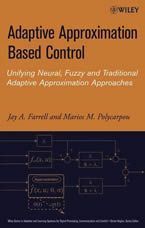
In parallel with developments in adaptive nonlinear control, there has been a tremendous amount of activity in neural control and adaptive fuzzy approaches. In these studies, neural networks or fuzzy approximators are used to approximate unknown nonlinearities. The input/output response of the approximator is modified by adjusting the values of certain parameters, usually referred to as weights. From a mathematical control perspective, neural networks and fuzzy approximators represent just two classes of function approximators. Polynomials, splines, radial basis functions, and wavelets are examples of other function approximators that can be used and have been used in a similar setting. We refer to such approximation models with adaptivity features as adaptive approximators, and control methodologies that are based on them as adaptive approximation based control. Adaptive approximation based control encompasses a variety of methods that appear in the literature: intelligent control, neural control, adaptive fuzzy control, memory-based control, knowledge-based control, adaptive nonlinear control, and adaptive linear control. |
 During the last few years there have been significant developments in the control of highly uncertain, nonlinear dynamical systems. For systems with parametric uncertainty, adaptive nonlinear control has evolved as a powerful methodology leading to global stability and tracking results for a class of nonlinear systems. Advances in geometric nonlinear control theory, in conjunction with the development and refinement of new techniques, such as the backstepping procedure and tuning functions, have brought about the design of control systems with proven stability properties. In addition, there has been a lot of research activity on robust nonlinear control design methods, such as sliding mode control, Lyapunov redesign method, nonlinear damping, and adaptive bounding control. These techniques are based on the assumption that the uncertainty in the nonlinear functions is within some known, or partially known, bounding functions.
 TABLE OF CONTENTS
 Chapter 6 - Approximation Approximation: Motivation and Issues
Chapters 2 and 3 have presented approximator properties and structures. Chapter 4 discussed and analyzed methods for parameter estimation and issues related to adaptive approximation. Chapter 5 reviewed various nonlinear control design methods. The objective of this chapter is to bring these different topics together in the synthesis and analysis of adaptive approximation based control systems. An additional objective of this chapter is to clearly state and intuitively explain certain issues that must be addressed in adaptive approximation based control problems. To allow the reader to focus on these issues without the distraction of mathematical complexities, in the majority of this chapter we will restrict our discussion to scalar systems. Adaptive approximation based control for higher order dynamical systems will be considered in Chapter 7. In addition to presenting nonlinear control design methods, Chapter 5 also discussed the effect of nonlinear model errors on the controller performance. Nonlinear damping, Lyapunov redesign, high-gain, and adaptive approximation were discussed as possible methods to address modeling error. The first three approaches rely on bounds on the model error to develop additional terms in the control law that dominate the model error. Typically, these terms are large in magnitude and may involve high frequency switching. Neither of these characteristics is desirable in a feedback control system. The role of adaptive approximation based control will be to estimate unknown nonlinear functions and cancel their effect using the feedback control signal. Canceling the estimated nonlinear function allows accurate tracking to be achieved with a smoother control signal. The tradeoff is that the adaptive approximation based controller will typically have much higher state dimension (with the approximator adaptive parameters considered as states). This tradeoff has become significantly more feasible over the past few decades, since controllers are frequently implemented via digital computers which have increased remarkably in memory and computational capabilities over this recent time span. The chapter starts with a general perspective for motivating the use of adaptive approximation based control. Then we develop a set of intuitive design and analysis tools by considering the stabilization of a simple scalar example with an unknown nonlinearity. Some more advanced tools are then motivated and developed based on the tracking problem for a scalar system with two unknown nonlinearities. |