In parallel with developments in adaptive nonlinear control, there has been a tremendous amount of activity in neural control and adaptive fuzzy approaches. In these studies, neural networks or fuzzy approximators are used to approximate unknown nonlinearities. The input/output response of the approximator is modified by adjusting the values of certain parameters, usually referred to as weights. From a mathematical control perspective, neural networks and fuzzy approximators represent just two classes of function approximators. Polynomials, splines, radial basis functions, and wavelets are examples of other function approximators that can be used and have been used in a similar setting. We refer to such approximation models with adaptivity features as adaptive approximators, and control methodologies that are based on them as adaptive approximation based control. Adaptive approximation based control encompasses a variety of methods that appear in the literature: intelligent control, neural control, adaptive fuzzy control, memory-based control, knowledge-based control, adaptive nonlinear control, and adaptive linear control. |
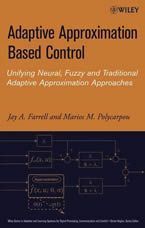 During the last few years there have been significant developments in the control of highly uncertain, nonlinear dynamical systems. For systems with parametric uncertainty, adaptive nonlinear control has evolved as a powerful methodology leading to global stability and tracking results for a class of nonlinear systems. Advances in geometric nonlinear control theory, in conjunction with the development and refinement of new techniques, such as the backstepping procedure and tuning functions, have brought about the design of control systems with proven stability properties. In addition, there has been a lot of research activity on robust nonlinear control design methods, such as sliding mode control, Lyapunov redesign method, nonlinear damping, and adaptive bounding control. These techniques are based on the assumption that the uncertainty in the nonlinear functions is within some known, or partially known, bounding functions.
 TABLE OF CONTENTS
 Chapter 8 - Adaptive Approximation Based Control for Fixed-Wing Aircraft
Various authors have investigated the applicability of nonlinear control methodologies to advanced flight vehicles. These methods offer both increases in aircraft performance as well as reduction of development times by dealing with the complete dynamics of the vehicle rather than local operating point designs (see Section 5.1.3). Feedback linearization, in its various forms, is perhaps the most commonly employed nonlinear control method in flight control [14, 34, 143, 165, 166, 250]. Backstepping-based approaches are discussed for example in [77, 98, 106, 107, 245]. Reference [135] presents a nonlinear model predictive control approach that relies on a Taylor series approximation to the system's differential equations. Optimal control techniques are applied to control load-factor in [96]. Prelinearization theory and singular perturbation theory are applied for the derivation of inner and outer loop controllers in [165]. The main drawback to the nonlinear control approaches mentioned above is that, as model-based control methods, they require accurate knowledge of the plant dynamics. This is of significance in flight control since aerodynamic parameters always contain some degree of uncertainty. Although some of these approaches are robust to small modeling errors, they are not intended to accommodate significant unanticipated errors that can occur, for example, in the event of failure or battle damage. In such an event, the aerodynamics can change rapidly and deviate significantly from the model used for control design. Uninhabited Air Vehicles (UAVs) are particularly susceptible to such events since there is no pilot onboard. For high performance aircraft and UAVs, improved control may be achievable if the unknown nonlinearities are approximated adaptively. This chapter presents detailed design and analysis of adaptive approximation based controllers applied to fixed-wing aircraft.1 Therefore, we begin the chapter in Section 8.l with a brief introduction to aircraft dynamics and the industry standard method for representing the aerodynamic forces and moments that act on the vehicle. The dynamic model for an aircraft is presented in Subsection 8.1.1. Subsection 8.1.2 introduces the nondimensional coefficient representation for the aerodynamic forces and moments in the dynamic model. For ease of reference, tables summarizing aircraft notation are included at the end of the chapter in Section 8.4. Two control situations are considered. In Section 8.2, an angular rate controller is designed and analyzed. That controller is applicable in piloted aircraft applications where the stick motion of the pilot is processed into body-frame angular rate commands. That section will also discuss issues such as the effect of actuator distribution. In Section 8.3, we develop a full vehicle controller suitable for UAVs. The controller inputs are commands for climb rate γ, ground track χ, and airspeed V. An adaptive approximation based backstepping approach is used. |