In parallel with developments in adaptive nonlinear control, there has been a tremendous amount of activity in neural control and adaptive fuzzy approaches. In these studies, neural networks or fuzzy approximators are used to approximate unknown nonlinearities. The input/output response of the approximator is modified by adjusting the values of certain parameters, usually referred to as weights. From a mathematical control perspective, neural networks and fuzzy approximators represent just two classes of function approximators. Polynomials, splines, radial basis functions, and wavelets are examples of other function approximators that can be used and have been used in a similar setting. We refer to such approximation models with adaptivity features as adaptive approximators, and control methodologies that are based on them as adaptive approximation based control. Adaptive approximation based control encompasses a variety of methods that appear in the literature: intelligent control, neural control, adaptive fuzzy control, memory-based control, knowledge-based control, adaptive nonlinear control, and adaptive linear control. |
 During the last few years there have been significant developments in the control of highly uncertain, nonlinear dynamical systems. For systems with parametric uncertainty, adaptive nonlinear control has evolved as a powerful methodology leading to global stability and tracking results for a class of nonlinear systems. Advances in geometric nonlinear control theory, in conjunction with the development and refinement of new techniques, such as the backstepping procedure and tuning functions, have brought about the design of control systems with proven stability properties. In addition, there has been a lot of research activity on robust nonlinear control design methods, such as sliding mode control, Lyapunov redesign method, nonlinear damping, and adaptive bounding control. These techniques are based on the assumption that the uncertainty in the nonlinear functions is within some known, or partially known, bounding functions.
 TABLE OF CONTENTS
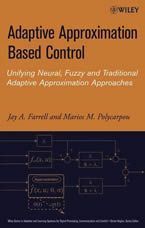
 Adaptive Approximation Based Control
Adaptive Approximation Based Control - Appendix B Recommended Implementation and Debugging Approach
The approach to implementation and debugging presented in this appendix has been defined based on interactions with numerous students and colleagues. The objective is to correctly implement a working adaptive approximation based controller.
It is important to not skip Steps 3 and 4. Skipping those steps can result in bugs in the basic control law implementation being misinterpreted as problems or bugs in the adaptive approximation process. The above stepwise derivation and debugging approach decomposes the problem into pieces that can be separably solved, analyzed, and debugged. |
 irepresent the approximation to i. Make sure that the controller implements ias a clearly distinguishable entity as it will be replaced later. For this step in the debugging process, assume some reasonable function for each iand let
© 2006 John Wiley & Sons, Inc.