Newnes Guide to Television and Video Technology

As we have seen from the previous chapter, when an ordinary analogue video is digitised, it requires as much as 124 Mbps for standard definition (SD) television, an inhibitive bandwidth of up to 62 MHz. To circumvent this problem, a series of data compression techniques have been developed to reduce the bit rate. The ability to perform this task is quantified by the compression ratio. The higher the compression ratio is, the lower the bit rate and with it the lower the bandwidth requirements. However, there is a price to pay for this compression as compression inevitably leads to increasing degradation of the image. This is called artefacts. However, advanced compression techniques are so sophisticated that they almost completely avoid the perception of artefacts. Inevitably, such techniques are complex and expensive.
The two basic compression standards are JPEG and MPEG. In broad terms, JPEG is associated with still digital images whilst MPEG is dedicated to digital video. The most popular MPEG standards are MPEG-2 and MPEG-4 with the former associated with SD and the latter with high definition (HD) television.
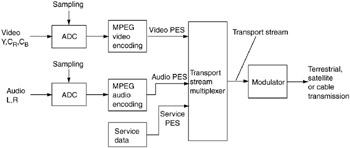
A digital television programme consists of three components: video, audio and service data (Figure 4.1). The original video and audio information is analogue in form and has to be sampled and quantised before being fed into the appropriate coders. The service data, which contains additional information such as teletext and network-specific information including electronic programme guide (EPG), is generated in digital form and requires no encoding.