Newnes Guide to Television and Video Technology
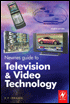
Chapter 25: Interconnectivity and Ports

As the count of electronic black boxes in the home increases, so do the number and complexity of the connections between them. The evolution of technology has brought with it progressively better and lower-loss signal linkages; over the years, we have moved from RF to composite video and then to S-video coupling for the picture and now use RGB links for some equipment. The advent of digital transmission and recording equipment, and the convergence of TV and computer technology and systems have spawned the domestic use of Firewire/IEE1394 data coupling. And increasingly we exchange control commands and data between boxes for the purposes of editing, automated recording, function switching and the like. This chapter examines the pros and cons of the various coupling and connection systems used in the domestic environment.

RF Connections

For full versatility in recording and viewing of broadcast transmissions, the UHF aerial feed must be looped through the VCR and terrestrial DTV box on its way to the TV set. Some equipment (particularly satellite boxes) can generate interference in the UHF band, in which case the use of double-screened cable like the CT 100 type used for satellite downleads can be helpful when used for inter-equipment links working at UHF. Even though VCRs and terrestrial DTV receivers must have a UHF input, it is far better that their modulators are switched off, and that their signal outputs go via AV (usually SCART) cables to avoid carrier clashes and consequent interference in the UHF band; these boxes...

UNLIMITED FREE
ACCESS
TO THE WORLD'S BEST IDEAS

SUBMIT
Already a GlobalSpec user? Log in.

This is embarrasing...

An error occurred while processing the form. Please try again in a few minutes.

Customize Your GlobalSpec Experience

Category: RF and Microwave Connectors
Finish!
Privacy Policy

This is embarrasing...

An error occurred while processing the form. Please try again in a few minutes.