Newnes Guide to Television and Video Technology

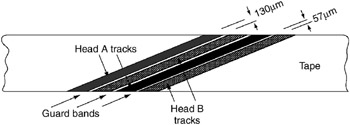
In the original VCR plan, a guard band was left between video tracks on the tape. This was true of the first machine to appear on the domestic scene, the Philips N1500. Linear tape speed here was over 14 cm/s, and the track configuration is shown in Figure 21.17. It can be seen that each video track is spaced from its neighbours by an empty guard band, so that if slight mist racking should occur, cross-talk between tracks could not take place. Each video track was 130 ?m wide and the intervening guard bands 57 ?m wide. This represents relatively low packing density of information on the tape, and it was soon realised that provided the tape itself was up to it, a thinner head could be used to write narrow tracks; if the linear tape speed was also slowed down the tracks could be packed closer together, eliminating the guard band. Using both ideas, tape playing time for a given spool size could be doubled or trebled. First, the problem of cross-talk had to be solved. Even if the mechanical problems in the way of perfect tracking could be overcome so that each head always scanned down the middle of its intended track, cross-talk would occur due to the influence of adjacent tracks, and the effect on the reproduced picture would be intolerable. A solution to this problem was found in the form of azimuth recording.