Newnes Guide to Television and Video Technology

Chapter 9: Video Re-Production

Overview

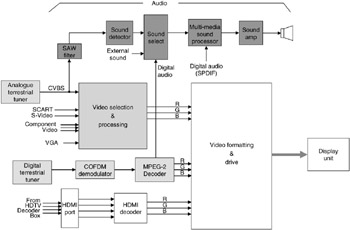
The process of television re-production involves video and audio processing as well as video formatting and drive for the particular video display unit. Figure 9.1 shows the major sections of the video section of a television receiver set. The video input may be from an analogue or digital source and the latter may be standard definition or high definition. The analogue video may take several formats:

  • CVBS signal obtained from an analogue terrestrial tuner or directly from a SCART connection.

  • Y and C from an S-video connection.

  • Component video Y, P r, P b.

  • RGB via VGA port.


Figure 9.1: Generalised block diagram of a TV re-production

These analogue video signals are first fed into the next chip which selects the video signal to processes it as determined by the viewer. Modern TV receivers are designed to receive direct audio/video (AV) input from external sources such as video recorders, camcorders, satellite receivers and digital television decoders. They also provide direct AV signals to peripherals such as video recorders and MPEG decoding audio systems. There are several ways for connecting AV devices to each other including the SCART connector, video coupling (S-video, component video, RGB), digital video interface (DVI), HDMI, VGA for PC, universal serial bus (USB), RS232 and FireWire. Refer to Chapter 25 for details.

Video processing includes colour decoding using a comb filter which separates the luminance Y signal from the chrominance components. The resulting RGB signals are then fed into the...

UNLIMITED FREE
ACCESS
TO THE WORLD'S BEST IDEAS

SUBMIT
Already a GlobalSpec user? Log in.

This is embarrasing...

An error occurred while processing the form. Please try again in a few minutes.

Customize Your GlobalSpec Experience

Category: Scan and Video Converters
Finish!
Privacy Policy

This is embarrasing...

An error occurred while processing the form. Please try again in a few minutes.