Newnes Guide to Television and Video Technology

Chapter 8: Channel Encoding

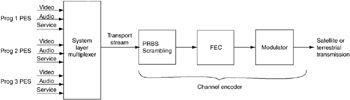
The transport stream emerging from the system layer multiplexer forms what is known as a channel. It is also known as a multiplex carrying a number of different programmes. Before transmission can take place, the packetised transport stream is first scrambled to obtain an even distribution energy across the channel. This is followed by forward error correction (FEC) before the signal is finally modulated and transmitted (Figure 8.1). The channel encoder is agnostic as the type of encoding (MPEG-2, MPEG-4, AVC, ACC, etc.). The delivery of audio and video encoded data is the same regardless of the encoding tools used.


Figure 8.1: Channel encoding

Scrambling

Scrambling is the process of rearranging the order of the data bits. It is not to be confused with encryption, which is the replacement of the original information by an alternative code pattern. Encryption is a secure system and it is used in conditional access applications where restrictions apply. Scrambling is used only for energy dispersal. The problem with plain unscrambled bitstreams is that they are likely to have long series of zeros and ones, which introduce a d.c. component. This results in an uneven distribution of energy making the transmission highly inefficient. If the bit-stream can be randomised and the series of 0s and 1s scattered, a more even energy distribution will be obtained. This is the purpose of scrambling. Totally random scattering is not possible as there is no way of descrambling the bits back to their original order at the receiver.

UNLIMITED FREE
ACCESS
TO THE WORLD'S BEST IDEAS

SUBMIT
Already a GlobalSpec user? Log in.

This is embarrasing...

An error occurred while processing the form. Please try again in a few minutes.

Customize Your GlobalSpec Experience

Category: Error Correction Chips
Finish!
Privacy Policy

This is embarrasing...

An error occurred while processing the form. Please try again in a few minutes.