Newnes Guide to Television and Video Technology
Chapter 13: Television Receivers CRT-Type

In the previous chapters, we described the various types of display devices from the traditional CRT to the plasma, LCD and the latest DLP rear-projection. The next few chapters will consider the technology involved in receiving and processing video signals in preparation for display.

There are several ways in which a video signal may be received for processing. These include the traditional analogue TV broadcasts as well as the current digital television. Video signals may also be received from a variety of video equipments such as DVD players, VCRs and set-top-boxes via a variety of connections such as SCART, S-video and HDMI. This chapter will cover terrestrial analogue television using a CRT display unit.

The Analogue TV Receiver

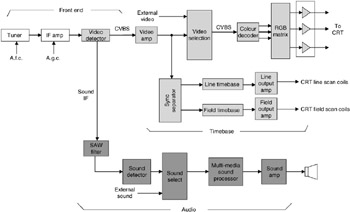
The basic functional units of an analogue terrestrial television receiver are shown in Figure 13.1.


Figure 13.1: Analogue terrestrial TV receiver

The tuner selects the UHF carrier frequency for the TV channel as chosen by the user and converts it to an intermediate frequency ( IF) of 39.5 MHz. The modulated IF is then amplified through several stages of amplification and demodulated to obtain the original composite video, blanking and sync (CVBS) signal. The CVBS signal is then separated into its three component parts: video, sound and sync.

The video selection switch (sometimes inappropriately called video processor) selects one of the video signal for further processing as chosen by the user. The video in the form of CVBS from the video selector is fed to the colour decoder

UNLIMITED FREE
ACCESS
TO THE WORLD'S BEST IDEAS

SUBMIT
Already a GlobalSpec user? Log in.

This is embarrasing...

An error occurred while processing the form. Please try again in a few minutes.

Customize Your GlobalSpec Experience

Category: Video Cameras
Finish!
Privacy Policy

This is embarrasing...

An error occurred while processing the form. Please try again in a few minutes.