Newnes Guide to Television and Video Technology

Transfer Characteristic and Bias

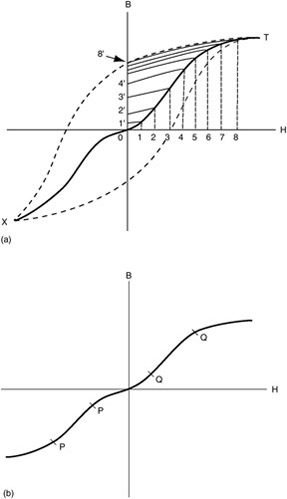
Figure 21.4a is based on the previous diagram, but shows the initial magnetising curve in solid line (T0X) with the hysteresis curve in dotted outline. If we apply a magnetising force, 1H, and then remove it, the remnant flux falls to a value 1 . A larger magnetising force 3H will, if applied and removed, leave a remnant force 3 , and so on, up to saturation point 8H and remanence point 8 . The same applies in the negative direction, and plotting remanence points against applied force we get the curve shown in Figure 21.4b. This is the transfer characteristic. It is very non-linear at the middle and ends, but for a typical recording type, will contain reasonably linear sections on each flank, PPand QQ. If we can bias the recording head to operate on these linear parts of the transfer characteristic, the reproduced signal will be a good facsimile of that originally recorded. The d.c. bias (Figure 21.5) puts the head into one of the linear sections, but the recorded signal will be noisy and inadequate; a.c. bias, shown at the top of Figure 21.5, allows the head to operate in two quadrants, with superior results. We shall see that the chrominance signal in a VCR is recorded along with a bias signal, which is in fact the FM carrier for the luminance signal.


Figure 21.4: Deriving the transfer curve: at (a) is plotted the remanent flux for eight linear steps of applied...

UNLIMITED FREE
ACCESS
TO THE WORLD'S BEST IDEAS

SUBMIT
Already a GlobalSpec user? Log in.

This is embarrasing...

An error occurred while processing the form. Please try again in a few minutes.

Customize Your GlobalSpec Experience

Category: Diodes
Finish!
Privacy Policy

This is embarrasing...

An error occurred while processing the form. Please try again in a few minutes.