Newnes Guide to Television and Video Technology

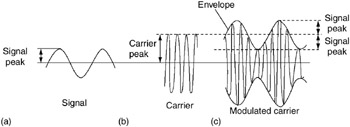
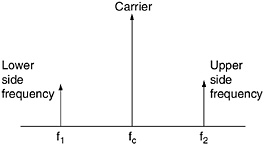
Amplitude modulation (AM) is amongst the earliest forms of modulation to be used, and is probably the easiest to understand. In AM, the amplitude of a sine wave carrier is made to change in accordance with a modulating signal. For instance, if the modulating signal was the sine wave shown in Figure A8.1a, then the modulated carrier will change its amplitude as shown in Figure A8.1c. When the modulated carrier is analysed, it is found to contain three sine wave components: the carrier f c and two side frequencies: f 1 and f 2 which are the difference and sum of the carrier and the modulating frequency respectively (Figure A8.2).
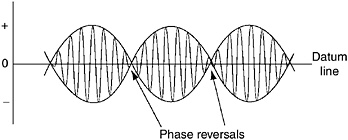
The information to be transmitted is duplicated in the two sidebands with the carrier itself containing no information at all. On top of that, the carrier has the highest amplitude and hence energy compared with the sidebands. Energy is thus wasted since the carrier contains no information. The carrier may be suppressed thus saving in power requirements without compromising the integrity of the transmitted information. As would be expected, a modulation waveform devoid of its carrier wave differs significantly from that with the carrier wave intact since the former is composed of only the upper and lower sidebands as illustrated in Figure A8.3.
It will be seen that the envelope has effectively collapsed , so that the top and bottom parts intertwine. Further, the...