Newnes Guide to Television and Video Technology
Chapter 16: Flat Panel Television Receivers

Overview

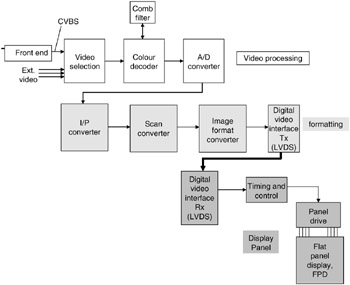
Unlike the cathode ray tube (CRT) display, flat panel displays (FPDs) have a fixed screen format or resolution. If the format of the incoming video is different from the native format of the panel, which it invariably is, image formatting has to take place to re-scale the incoming resolution of the received video to that of the panel. Figure 16.1 shows the main parts of a FPD television.


Figure 16.1: Flat panel television receiver

A FPD TV receiver consists of three main sections:

  • Video processing,

  • Formatting,

  • Display panel.

The video section receives video signals from a variety of sources including

  • Tuner (CVBS),

  • AV, e.g. SCART (YC, CVBS, RGB, Y, Pr, Pb),

  • DVI ( digital video interface),

  • PC (serial, VGA).

One of these inputs is selected by the video selection switch (sometimes called video processor) to be sent to the colour decoder which in conjunction with the comb filter separates the luminance from the chrominance to obtain the three RGB signals. These are then converted into a digital multibit stream by the analogue-to-digital converter (ADC). The connection to the next section is normally direct or where a longer connection is needed, as in the case of a PC, it may be attained via a DVI, normally a transition minimised differential signalling ( TMDS) interface. The formatting section carries out the necessary conversion including interlace-to-progressive, scan conversion and image formatting to re-scale the image to the native resolution...

UNLIMITED FREE
ACCESS
TO THE WORLD'S BEST IDEAS

SUBMIT
Already a GlobalSpec user? Log in.

This is embarrasing...

An error occurred while processing the form. Please try again in a few minutes.

Customize Your GlobalSpec Experience

Category: Scan and Video Converters
Finish!
Privacy Policy

This is embarrasing...

An error occurred while processing the form. Please try again in a few minutes.