Newnes Guide to Television and Video Technology

Chapter 19: Projection Systems

Overview

Projection displays utilise an optical system to magnify a small picture created either by a conventional direct-view technology, such as a CRT, or by the use of light modulating system ( LMS). An LMS employs a 3 5 cm microdisplay panel as a light valve ( LV) to modulate the light. A projection display can be operated either in front-projection ( FP) mode, where the viewer and projector are on the same side of the screen, or in rear-projection ( RP) mode, where the viewer and projector are on the opposite side of the screen.

There are three major LV technologies, namely the digital micromirror device ( DMD), the high-temperature polycrystalline silicon ( HTPS) and the liquid crystal on silicon ( LCoS). Each technology has unique properties that determine the image quality.

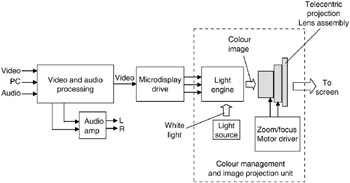
A microdisplay-based projection system (Figure 19.1) consists of the following major parts:

  • Video and audio processing

  • Microdisplay drive

  • Colour management and image projection


Figure 19.1: Microdisplay-based projection system

The colour management and image projection system contains the microdisplay, the light source assembly, the light engine and the telecentric optical lens. The input which could be in the form of composite, component or digital video is processed and the image resolution scaled to the native resolution of the microdisplay. RGB signals are then fed to the microdisplay drive on its way to the light engine. Stereophonic audio input is also processed and amplified as shown. Light from a...

UNLIMITED FREE
ACCESS
TO THE WORLD'S BEST IDEAS

SUBMIT
Already a GlobalSpec user? Log in.

This is embarrasing...

An error occurred while processing the form. Please try again in a few minutes.

Customize Your GlobalSpec Experience

Category: Projection Screens
Finish!
Privacy Policy

This is embarrasing...

An error occurred while processing the form. Please try again in a few minutes.