Newnes Guide to Television and Video Technology
Chapter 14: Television Receivers Colour Processing

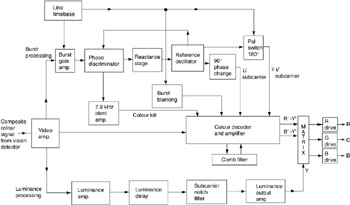
You will recall from Chapter 2 that the chrominance information is contained in a 4.43-MHz modulated sub-carrier which forms part of the incoming composite video signal. Colour difference signals B ? ? Y ? and R ? ? Y ? are used to modulate the sub-carrier, which is then suppressed to leave two quadrature components, U and V. At the receiver, the chrominance information is separated from the luminance signal by a comb filter, decoded and applied to a matrix network, which performs the operation necessary to reproduce the original RGB colour signals that can be applied to a colour tube. Figure 14.1 shows a block diagram of the major functional units required for TV video processing. It consists of two major processing sections: luminance and chrominance. Chrominance processing itself consist of four distinct parts: a colour burst section, a colour decoding section, a matrix and a colour drive amplifier.


Figure 14.1: Colour TV video processing

Colour Burst Processing

Colour burst processing separates the sub-carrier burst signal from the chrominance information so it may be used to recreate the sub-carrier which has been suppressed at the transmitter. The sub-carrier has to be restored in both its frequency and phase to ensure correct colour reproduction. Two sub-carriers at 90 to each other have to be produced, one for each colour difference, B ? ? Y ? and R ? ? Y ?. Furthermore, in the PAL system, the sub-carrier for the...

UNLIMITED FREE
ACCESS
TO THE WORLD'S BEST IDEAS

SUBMIT
Already a GlobalSpec user? Log in.

This is embarrasing...

An error occurred while processing the form. Please try again in a few minutes.

Customize Your GlobalSpec Experience

Category: Scan and Video Converters
Finish!
Privacy Policy

This is embarrasing...

An error occurred while processing the form. Please try again in a few minutes.