Newnes Guide to Television and Video Technology

Head-Tape Flux Transfer

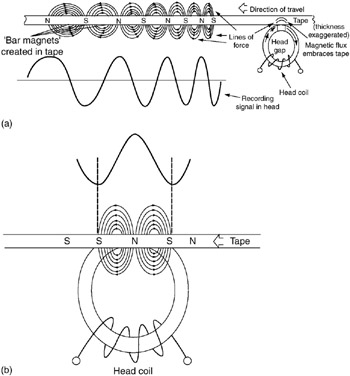
The recording head consists of a ferrite ring , with its continuity broken by a tiny gap. A coil is wound around the ring, and when energised it creates a magnetic field in the ring; this is developed across the head gap. As the tape passes the gap, the magnetic field embraces the oxide layer on the tape and aligns the internal magnets in the tape according to the electrical signal passing through the head. Provided that some sort of bias is present (Figure 21.5) the relationship between writing current and flux imparted to the tape is linear, so that a magnetic facsimile of the electrical signal in the head is stored in the tape, as shown in Figure 21.6a. The tape passes the head at a fixed speed, so that low frequencies will give rise to long magnets in the tape, and high frequencies short ones.


Figure 21.6: Storing flux on the tape: at (a) the flux appearing across the head gap is penetrating the oxide surface to leave magnetic patterns stored on the tape; (b) shows the effect when one complete cycle of the recorded waveform occupies the head gap no signal transfer will take place. This point represents f ex, extinction frequency

The linear relationship between head field strength and stored flux in the tape, described above, holds true when the wavelength to be recorded on tape is long compared with the width of the head gap. However, when the wavelength of...

UNLIMITED FREE
ACCESS
TO THE WORLD'S BEST IDEAS

SUBMIT
Already a GlobalSpec user? Log in.

This is embarrasing...

An error occurred while processing the form. Please try again in a few minutes.

Customize Your GlobalSpec Experience

Category: Magnetic Chucks
Finish!
Privacy Policy

This is embarrasing...

An error occurred while processing the form. Please try again in a few minutes.