Newnes Guide to Television and Video Technology

The Azimuth Technique

For good reproduction from a tape system, it is essential that the angle of the head gap on replay is exactly the same as was present on record with respect to the plane in which the tape is moving. In an audio system, the head gap is exactly vertical and at 90 to the direction of tape travel. If either the record or replay head gap is tilted away from the vertical, even by a very small amount, tremendous signal losses occur at high and medium frequencies, the cut-off point travelling further down the frequency spectrum as the head tilt or azimuth error is increased. If the same head is used for record and replay (as is usually the case in audio tape recorders), the azimuth error will not be noticed, because there is no azimuth difference between record and replay systems.

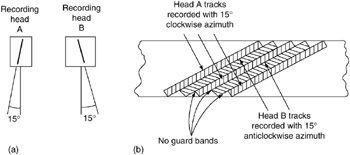
This azimuth loss effect is the key to successful recording and replay of video signals without a guard band. Let s designate our video heads A and B, and skew A s head gap 15 clockwise and B s head gap 15 anticlockwise as in Figure 21.18a. This imparts a total 30 difference in azimuth angle between the two heads, and the result is video tracks on the tape like those in Figure 21.18b.


Figure 21.18: Azimuth offset. The head gaps are cut with complementary azimuth angles so that the guard bands of Figure 21.17 can be eliminated

With the built-in error of 30 ,...

UNLIMITED FREE
ACCESS
TO THE WORLD'S BEST IDEAS

SUBMIT
Already a GlobalSpec user? Log in.

This is embarrasing...

An error occurred while processing the form. Please try again in a few minutes.

Customize Your GlobalSpec Experience

Category: CCD Cameras
Finish!
Privacy Policy

This is embarrasing...

An error occurred while processing the form. Please try again in a few minutes.