Newnes Guide to Television and Video Technology

Modern consumer equipment employs one or more processing devices to carry out such functions as programming, synchronisation and control. Four types of processor chips may be used:
General purpose microprocessors for general system programming and control
Dedicated microprocessors such as video decoders or RF processor
Microcontrollers
System-on-a-chip
Three main technologies are employed in the fabrication of integrated circuits: TTL, CMOS and NMOS. The latter two types are normally used because of their high component density.
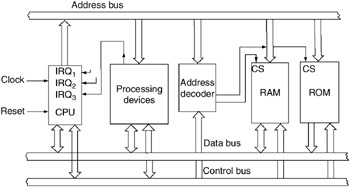
The architecture of a microprocessor-based system is shown in Figure A4.1. It consists of the following component parts:
Central processing unit ( CPU)
Memory chips: various types of RAM and ROM
Address decoder chip
Processing devices
Bus structure
The CPU is usually a single VLSI (very large-scale integration) or ULSI (ultra large-scale integration) chip containing all the necessary circuitry to interpret and execute program instructions such as data manipulation, logic and arithmetic operations and timing and control. The capacity or size of a microprocessor chip is determined by the number of the data bits it can handle. A16-bit chip has a 16-bit data width; a 32-bit processor has a 32-bit data width and so on. Eight-bit and 16-bit processors are generally employed as dedicated controllers in industrial applications and domestic appliances such as robots, washing machines and TV receivers.
Microprocessors differ in the speed by which they execute...